

January 12, 2018 Interview with Literary Agent Tracy Marchini of BookEnds
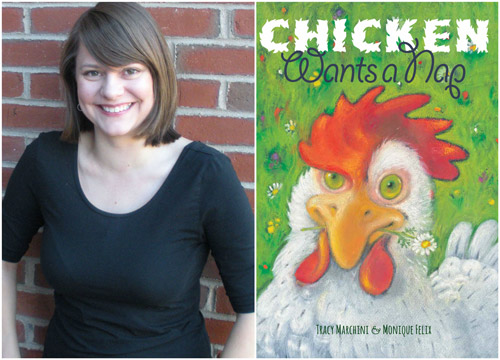 About Tracy:
Tracy Marchini is a Literary Agent at BookEnds Literary, where she represents both debut and award-winning authors and illustrators of fiction and non-fiction for children and teens. To get a sense of what she’s looking for, you can follow her Twitter #MSWL, see her announced client books, and read her submission guidelines.
As an author, her debut picture book, Chicken Wants a Nap, was called “A surprising gem” in a starred review from Kirkus. She’s been accepted for publication in Highlights Magazine and has won grants from the Highlights Foundation, the Puffin Foundation and La Muse Writer’s Retreat in Southern France. She holds an M.F.A in Writing for Children and a B.A. in English, concentration in Rhetoric.
How to connect with Tracy:
Website: www.tracymarchini.com
Twitter: www.twitter.com/TracyMarchini
Instagram: www.instagram.com/tracymarchini
Facebook: www.facebook.com/tracymarchinibooks
How and why did you become an agent? How did you know it was the right career for you?
After I graduated college, I knew I wanted to work in children’s publishing and so I started sending out my resume to every agency and publisher I could find. I sent out 170ish resumes and didn’t receive a single interview. But I went to my local SCBWI conference, where I met Gail Carson Levine. She offered to pass along my resume, and that’s how I ended up with my first agency internship, which subsequently led to my first full time job as an agents’ assistant.
I’ll admit that when I first started, I didn’t know if agenting was the right career for me and at some points I did consider editorial. But now I can’t imagine moving over. There’s so much freedom in agenting – I can build my list of clients based solely on what I love and think that I can sell. I’m an editorial agent, so I get to do that work to make a book as strong as we possibly can before sending it out to publishers. And maybe this isn’t popular – but I love contracts, too. It uses a different part of my brain, and I love thinking about how a contract clause’s implications might change as, for example, technology changes.
What’s your overall goal and vision as an agent?
Above all, I want to help my authors and illustrators put beautiful, inspiring, hopeful and/or funny books in the world. I want to make sure that my clients’ careers are growing – both in craft and in more practical ways. And I want to make sure that my list is curated so that I have the time to devote to my clients. Which means, unfortunately, that I have to be very selective. There are things I’ve passed on that I knew would sell (and have) but that I knew I wasn’t 100% the right fit.
I also want to make sure that my list is as inclusive as possible. Marie Wilson says, “You can’t be what you can’t see.” And I think that’s absolutely applicable to children’s books. All children need to be able to see themselves (or someone like them) as the hero.
What are you currently looking for?
I represent authors and illustrators of picture book, middle grade and young adult fiction and non-fiction. In picture book fiction, I love things that are clever or witty and things that are deliciously dark.
In middle grade, I love contemporary family and friendship stories – sometimes with just a dash of magic. In young adult, I love grittier contemporary stories – and would also be in the mood for a good road trip novel. While my primary love in mg and ya is contemporary, I’m also looking for historical fiction and magical realism.
In non-fiction across all age groups, I’m looking for unsung heroines and heroes, moments in history that changed the world but are often overlooked, and things that highlight women in STEM.
What’s something you’re looking for and not getting that you would like to see in your slush pile?
I’m still on the hunt for a good middle grade mystery series. Send me the next Sammy Keyes! I’m also looking for middle grade and young adult graphic novels, and lean towards contemporary stories here too, but am open to just about any genre here. (Except horror for YA – I can’t do that in any format!)
What are you definitely not a good fit for?
I personally am not a good fit for:
- Leprechauns
- Angels
- Horses
- Santa Claus stories
- Books about potty training or where poop and/or boogers are the protagonist
- Stockholm syndrome romance or anything with a significant age gap (like a 400-year-old vampire and a sixteen-year-old. I just can’t get past the life experience difference.)
- Anything that would sell in the inspirational or educational market.
- Memoirs from adults looking back on their teenage years.
What’s something you’ve sold that comes out soon that you’re excited about?
In 2018, my first set of client books come out and I’m very excited about all of them!
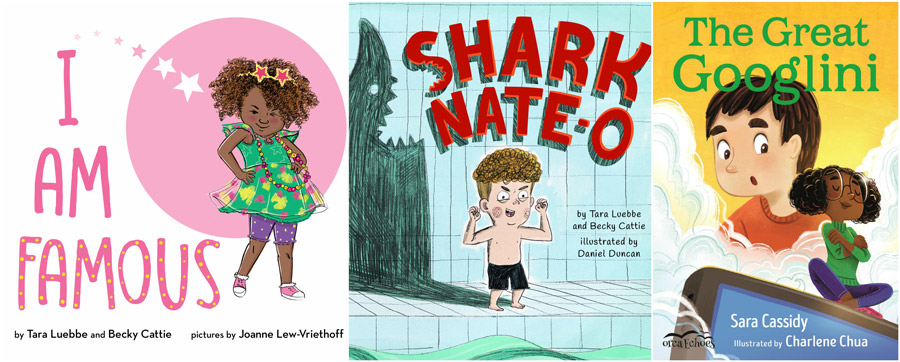 Tara Luebbe and Becky Cattie debut with I Am Famous and Shark Nate-O in March and April, respectively. Multi-published picture book illustrator Charlene Chua’s first chapter book, The Great Googlini (written by Sara Cassidy), comes out in October. And Meera Sriram’s first US-based book, The Yellow Suitcase, publishes this Fall. (She was previously published in India.)
There’s a slew of books coming out in 2019 that I’m excited about as well, and you can see everything that’s been announced for my clients here: http://tracymarchini.com/client-books/
Does your wish list depend on what you already represent, your current reading interests, the demands of the market, or a mixture?
It’s a little bit of everything. If there’s something I love, but the market has already told me that I can’t sell at the moment, then I would be hesitant to take that book on without a real frank conversation with the author. And maybe that conversation focuses heavily on that next book they’re writing. Because I’m not looking to take on just one book – I want to take on an author’s entire career.
What are some ways you feel literary agents can increase diversity in publishing?
I would love to talk more about class when we talk about diversity and inclusion across agencies, publishers and who/what is published. The truth is we’re still very much an apprenticeship industry, and plenty of us had to intern for free for six months to a year before we could find our first paying job. So already that’s going to cut out a segment of the population that can’t afford to work unpaid – or whose parents can’t afford to be their safety net. Because once you get that first job, it still pays significantly less than a lot of other professions. Entry level in publishing tends to be in the low 20’s to low 30’s – and New York is one of the most expensive cities in the world.
I am happy to say that the tide is turning towards paid internships – and BookEnds now offers one too! But there’s still that barrier to stay, when wages are so low and rents are so high. I honestly don’t have a great solution to that, but I think it’s worth discussing.
The difference in class also plays into what’s in the submission box, too. There’s a clear advantage to being able to afford writer’s workshops, conferences, critiques, graduate programs, etc. And while there’s a number of fantastic initiatives out there, perfecting the craft of writing takes years. So I hope that sort of financial and mentorship support increases as we work to create more opportunities for those with the drive but without perhaps the financial means and/or the luxury of time.
Any final advice for writers and/or illustrators seeking an agent?
Do your research, follow submission guidelines and always be professional. Agents and editors change houses and roles all the time – so you never know where someone will land and/or who their new colleague will be!
WILDCARD Question
If you could trade places with any other person for a week, famous or not famous, living or dead, real or fictional, with whom would you trade?
Whenever I watch The Crown, I feel like “I could do that for a week.” But probably only a week – I’d imagine the luster would wear off pretty quickly with all the newfound restrictions!
Thank you for your time, Tracy!
Sorry, the comment form is closed at this time.