

November 14, 2018 Interview and Giveaway with Author, Pam Calvert
About:
I’m especially honored to welcome to the blog this week, my 2018 PBWWTS mentor, author, Pam Calvert.
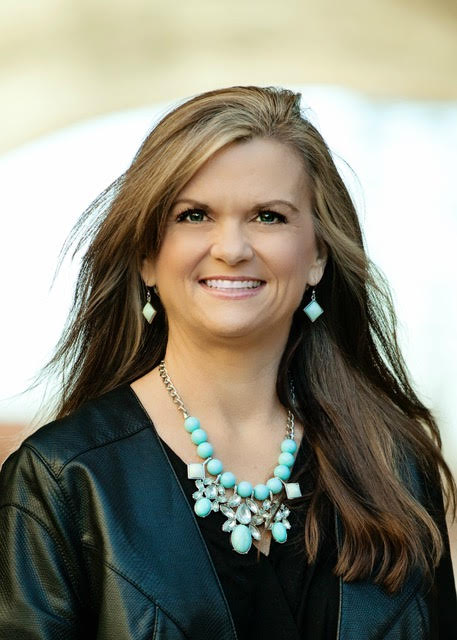 Pam Calvert is an author of children’s picture books, easy readers, and short stories. She has five picture books published with more on the way. Her newest book is a character driven series entitled, BRIANNA BRIGHT BALLERINA KNIGHT (Two Lions, 2018) as well as another with series potential, FLASH: THE LITTLE FIRE ENGINE (Two Lions, 2019). Her Princess Peepers series has won awards, and most of her books are Scholastic Book Club titles. She offers a free picture book workshop, Picture Book University http://www.picturebookuniversity.com on her blog as well as a highly praised critique service http://wwwpamcalvert.blogspot.com/p/pb-critiques.html.
You can find her on:
Twitter: @pammcalvert
Website: www.pamcalvert.com.
1) What’s your writing process like?
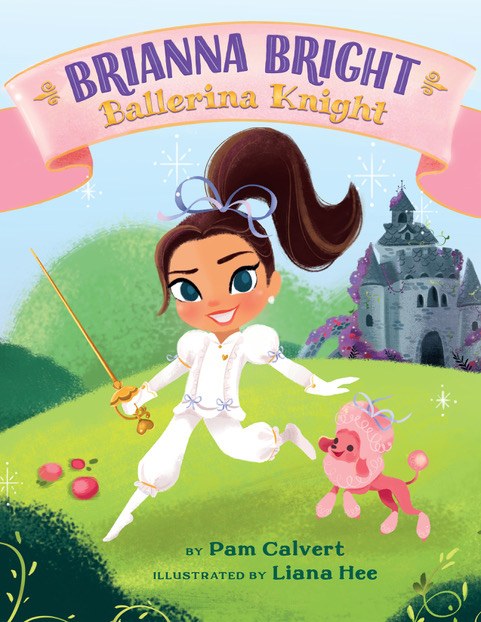 It’s different for what I’m going to write. Novels take loads of planning, outlining, etc. (And scheduled time to write–I write in the morning, mostly every day–at least 500 words a day). Picture books are like wisps in the air. When I get an idea, I’ll write it down. I keep idea notes on my phone. It may take months (or years) for me to get the inspiration to make it into a story. For Brianna Bright, I got the idea quickly, melding some elements of things I love (pink frilly things/strong girl power elements) and the story basically wrote itself. Didn’t take more than a few weeks from idea to finished manuscript. For my newest book (that is set to come out November 2019), I got the idea months before I wrote it. I didn’t have a working idea on how the plot would go. I knew I wanted to write about a fire truck, but since I wasn’t surrounded by emergency vehicles in my daily life (nor did I study them in the past), I had my son in law help me with some ideas. Once I figured out what the truck’s major problem would be (being too little to help out or too slow) then the story came a bit easier. Took about six months from idea to finished manuscript. The current picture book I just sent my editor was years in the making. I got the idea about four years ago, but couldn’t think of a good plot until a year ago when I started on it. I’ve been going back to it, perfecting it and now, finally, it’s with my editor. I’m crossing my fingers! 😀
2) When you edit your own manuscripts what exactly are you looking for or tend to find yourself questioning and/or fixing?
If I’m not satisfied with it (meaning the story isn’t flowing well, I don’t like the twist ending, the story doesn’t seem strong enough) then I’ll give it to my critique group to help me “see” what’s wrong. Having others take a look can really help when you’re too close to the manuscript. I make sure it’s VERY accessible to kids–has a lot of kid thinking, funny picture elements, lots of action, fun words that can be highlighted, etc. If I don’t see enough of all of those elements, I’ll add to it. I also pay close attention to word count (between 450-650 words). Much of what goes on in a story can be told in the pictures and I’ll use illustration notes to help my editor see what’s going on. I don’t advise you to do a whole lot of that starting out. You need to wow an editor with your wonderful words (and I make sure I have lots of rhythm and style elements in all my stories. Read my article about that here: STYLE ELEMENTS http://wwwpamcalvert.blogspot.com/2013/08/picture-book-university-style-elements.html)
 3) Can you tell us more about your most recent picture book Brianna Bright, Ballerina Knight?
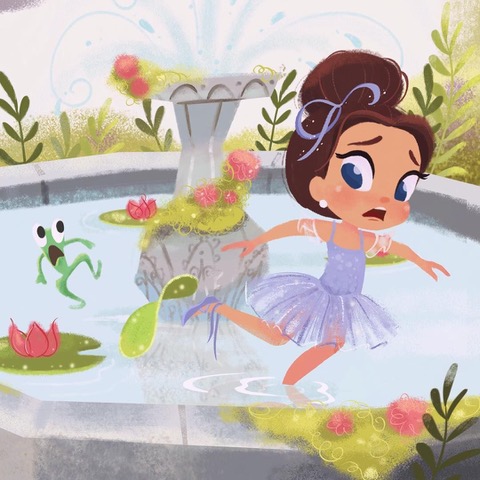
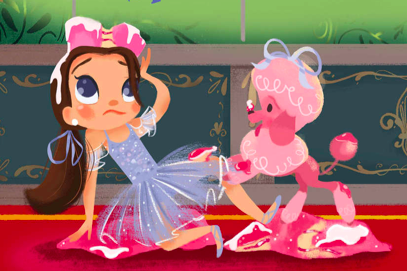
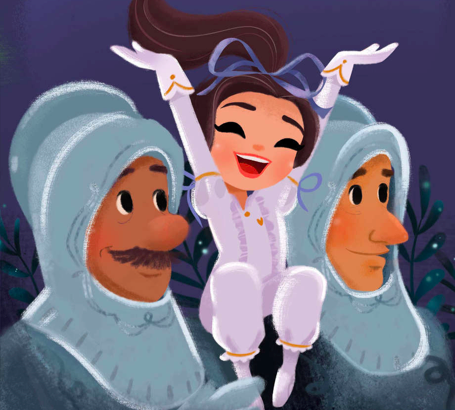
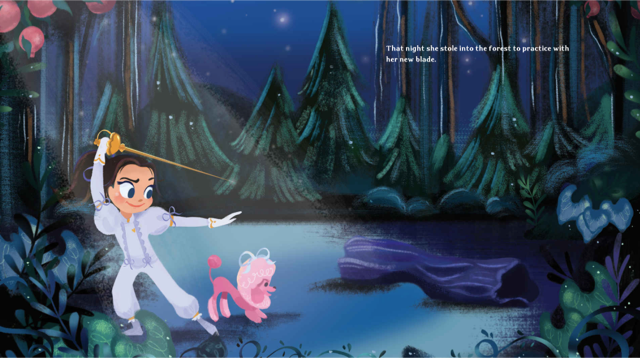
Brianna Bright loves to dance, but she isn’t very good at it. She bumbles around a lot until her father suggests doing something else. She goes through many different hobbies until she finds…fencing! But she isn’t good at that either. She must combine her talents to succeed and save the castle!
 4) What sparked the idea for Brianna Bright, Ballerina Knight?
I knew I wanted to write a ballerina book but there were too many books out there about ballerina girls. I love strong women and strong girl themes. I was a big fan of Game of Thrones at the time and remembered Arya Stark doing “water dancing” where she was learning how to sword fight as a sort of dance. Having the blade helped her balance and it gave me the idea to add fencing to Brianna’s plight. And then I thought being a princess would add sparkle to the whole idea. There’s never been a ballerina princess knight. EVER! And it sold quickly.
 5) What were the challenges you had to encounter to complete Brianna Bright, Ballerina Knight?
That book wasn’t hard for me to finish. What was hard was when my editor loved it and then gave me different changes. We must have done about 18 different edits on it to get it “just right”. At first, Brianna was a typical medieval princess, but my editor wanted me to modernize it. In the end, we melded both ideas–traditional fairytale princess with modern elements (Brianna plays soccer, rides a skateboard, etc.)
 6) What was the timeline like for Brianna Bright, from idea inception to publication and what were the major events along the way?
This was the worst as far as timeline went–it was sold in 2014–took four years to get published. That’s crazy. Usually, it takes 2 years and with amazon’s capabilities, it can be much shorter. But it took months to find the right illustrator. Two Lions wanted a commercial artist. First they went to Disney. We almost got the woman who was the visual artist for Frozen. But she was too busy and had to decline. She then mentioned her friend, Liana Hee, who was the visual artist for Nick Jr.’s Shimmer and Shine. Unfortunately, things happened to the artist that made her delay. And so…instead of coming out in 2016 like it was supposed to, it came out this year. To make up for this, Two Lions is really trying to step up their efforts for my next book, FLASH THE LITTLE FIRE ENGINE. It was accepted in January 2018 and I already approved the initial sketches. It’s set for next November 2019! I have such a great team at Two Lions. Cannot say enough good things about publishing with them.
7) What’s been the most difficult obstacle for you during your path to publication and how have you dealt with it? Is it something you still deal with?
Most difficult is rejection. In any form. Of course I still suffer rejection. I’m sure I always will. I would love to say that my editors take whatever I write, but that just isn’t the case. It’s gotten easier over the years since I’ve gotten better at my craft, but it isn’t foolproof. For example, I wrote a cute monster picture book that my editor loved. But she couldn’t accept it because she’d just recently acquired two other monster books. To help me, though, she said she’d take it in a few years if I hadn’t sold it but she really wanted me to send it out. Isn’t that nice? Her kind words helped in the sting of it.
8) Any new projects you’re working on that you’d like to share with us?
I’m working on a young adult action/thriller/scifi/romance at the moment. Other than that, I just sent in my newest picture book to my editor and am in wait mode on that. It’s about two cats—a crotchety older cat (Sensei) who’s world is turned upside-down by a new, freakishly spunky kitten (Pounce). These characters are based off my daughter’s cats (who are hilarious, btw).
9) What led you to begin critiquing picture book manuscripts? Do you critique manuscripts for other audiences?
Tara Lazar had asked me to do an article on her blog and with all the questions about my process, etc, I figured I needed to start a blog that could help others write picture books. I thought I’d add a critique service since that would also help out people once they did my workshop and so Woven With Pixie Dust was born! I’ve really loved seeing how my clients’ work improve.
I do not critique work for middle grade or young adult work simply because although I’ve been agented for all genres–middle grade, young adult, chapter books as well as picture books, I just don’t think I have the time to do that.
10) What’s your favorite part about critiquing manuscripts?
When I see brilliance on the page and can picture it being a real book–that’s the best. For example, I remember when Lindsay Bonilla came to me with an early rendition of POLAR BEAR ISLAND. Back then, it was a wonderful journey story, but I remember loving how creative it was. Then I received a message from her that it was sold to Sterling. She wrote to thank me. That’s the most thrilling part–helping others succeed! Here’s a link to her book: POLAR BEAR ISLAND
11) When looking over manuscripts what catches your eye? What things do you pay attention to most?
The characters are what stand out to me the most–I look at who they are and how they will relate to children. Then I look at how the story is set up. It doesn’t have to be in a standard story structure. As long as the structure makes sense, I’ll go with it. I also see if it’s understandable and if I can help them with some of my workshop articles. I look at what’s in the market and figure out if it’ll stand out enough. I’ll also think hard about how the author can move the story up a level–adding creative elements or helping them see some ways they can change it to be more visual. After that, I make sure to do a line by line edit with lots of notes with my thoughts. If I think the story is great and doesn’t need much, I’ll say so. That happens rarely though.
12) Do you approach editing your own manuscripts any differently than when you’re critiquing another author’s text?
Yes. When editing mine, I’m going through sort of like a last revision–I’m familiar with my story, I know I’ve set it up to relate to children, I know it’s marketable (or I wouldn’t have written it in the first place, etc.) so my edits of my work are really contingent upon my critique group. I care about what they say and I’ll implement their thoughts. I’ll make sure I’m satisfied with my ending and make sure the story flows. For others’ work, I’ll see if it’s up to publishing standards, look at the structure, visual storytelling, style elements, kid focus, etc. Then I’ll figure out how they can rework it so it’s stronger. A lot of that is done already when I approach writing my own work so I don’t have to evaluate it at that level.
13) What’s the most common challenge picture book clients have when they come to you for guidance and help?
I’d say there are two types of clients–those who already are very advanced and just need a refined eye and those who are true beginners. I don’t mind evaluating both groups, but those who have no idea how to write picture books or who haven’t read much or haven’t studied them at all are not going to get the most out of what I offer. That’s a real challenge because I end up pointing them to a picture book class and can only offer a minimal amount of feedback that I think will help because they probably need to redo the whole story or their idea just won’t work for the market (i.e., the idea is for adults or what adults think children “need” to learn.)
14) What are the most common problems you see in the picture book manuscripts you edit? And what are the usual remedies to these problems?
Most common problems are:
- Not enough conflict
- Seen from an adult’s perspective or what an adult thinks a child should know
- Not interesting visually. (Talking heads or the same setting throughout.)
- Bad grammar
- No stylistic elements
Usual remedies? I normally have them do some of my assignments from my free picture book workshop. Or I’ll have them analyze some picture books and see how the author approached them. If they don’t know how a picture book is set up structurally or they have awful grammar or really aren’t familiar with even reading picture books, I’ll suggest some classes. Otherwise, I may have creative ideas to help get their creativity going–I’ll ask them questions about the plot, character, plotlines, conflicts, etc.
15) How do you approach critiquing a non-fiction pb manuscript versus a work of fiction?
There’s really no difference in how I approach the edit except sometimes nonfiction will have sidebars and I’ll be aware of this and often suggest adding some (many people don’t realize you should have these in nonfiction.) Nonfiction should still have creative elements and stylistic elements, it’s just done a bit differently.
16) Are there topics or genres in picture books that you feel there’s not enough of or you’d simply like to see more of when critiquing manuscripts?
There’s not enough humor. Most people write a journey story about a child going along in his day or about something a child needs to learn.
17) Any advice for writers struggling to secure representation with their picture books and are being asked about what else they’re writing (e.g. mg and ya)?
If you’re in the middle of writing a middle grade or YA and have a few picture books you want representation, I’d say wait to get that agent until you’re finished. That’s what I’m doing. Even though I have a few picture books I could send around and get an agent, I want one who loves my YA–but it’s not done yet, so I’m going to wait until that’s finished. 🙂 I know I could probably find one with just my picture books but that would be awful if she/he didn’t like my YA.
18) Would you tell us more about your free resource, Picture Book University, and how it came about?
I created Picture Book University because many people asked me over and over about my process of writing a picture book. I thought I should blog about one aspect every month or so until I got enough topics for a “mini” workshop. I also did reviews of some of my favorite picture books. I’ve been thinking about doing a paid workshop called Picture Book University Masters…but I’ve been too busy to implement it. Maybe next year, though. (This year, my family moved and I’ve been crazy busy with promotion of Brianna Bright and writing a novel.)
19) When, if at all, do you suggest picture book writers have their picture book manuscript professionally critiqued?
If you don’t have a picture book critique group that’s full of advanced writers or published writers, a paid critique is a great way to get your manuscript ready for submission. I’d advise people to do this if they’ve done my Picture Book University workshop first. Put the manuscript through that–often you’ll find ways to make it better by doing those assignments. Then once you’re done, getting an expert’s opinion is really great in figuring out how to make it the best it can be–ready for the market.
If you’re new to writing and really don’t have much experience at all, the best thing to do is take a class. You can learn more about my advice on that here: PBU Extra http://wwwpamcalvert.blogspot.com/2015/04/picture-book-university-extra-take.html
20) Where can picture book writers go to learn more about your critique services and what should they expect when working with you?
They can go to this page: http://wwwpamcalvert.blogspot.com/p/pb-critiques.html I’ll do a line by line edit, analyze the market and how it might fit, give my thoughts on how they can take it to the next level to wow an editor, help them with professional development, etc. I can’t guarantee publication, but I’ll try my best to offer advice on how to make it as market ready as possible. Also, if you’re wanting to self publish, my critiques will help in giving it that polished quality. I analyze differently when knowing you’re selfpublishing. You have more freedom in what you write since you don’t have to please the “gatekeepers”.
21) If you had to recommend two picture books as mentor texts for beginning picture book writers, which two would you choose? And what lessons would they impart?
Read my picture book analysis Nugget and Fang by Tammi Sauer: http://wwwpamcalvert.blogspot.com/2013/06/picture-book-analysis-nugget-and-fang.html That book has every element in it that I think makes for a “perfect” picture book. Another is Lily’s Purple Plastic Purse by Kevin Henkes. The wordcount is too high, but it has everything one should understand when approaching children’s picture books-kid focus, rhythm, stylistic elements, great structure, humor, visual thinking, etc.
22) Do you have any words of advice for unpublished picture book writers?
Think about if you REALLY want to do this–is it a passion? Or do you think you have some wisdom that you want to impart on the little children of the world? If it’s the latter and not the former, I’d say you need to rethink your idea. Picture books are very hard to master. It took me years of hard work, study and loads of writing to sell just one. If you’re passionate, read everything about writing for children, take classes, go to conferences, immerse yourself in reading TONS of picture books. And write. When you receive a rejection, don’t give up! Because if you do, you’ll never realize your dream.
Thanks for your time, Pam!
Pam is graciously offering two signed copies of Brianna Bright, Ballerina Knight and two picture book critiques to five very lucky winners. Enter the Rafflecopter widget below for your chance to win. You can an earn extra entry for each entry option you complete. Critique prize is open to international participants (signed books are not). One prize per winner.
Sorry, the comment form is closed at this time.