

January 14, 2019 Interview with Joyce Sweeney
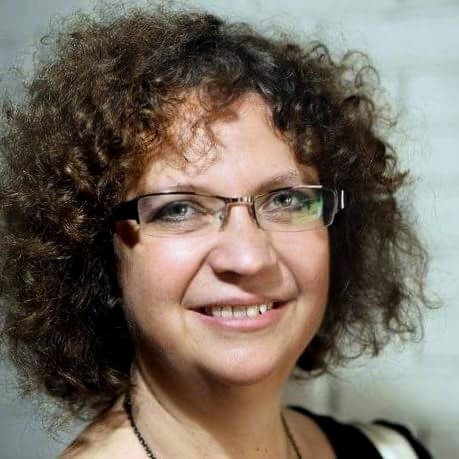 About Joyce: Joyce Sweeney is the author of fourteen novels for young adults and two chapbooks of poetry. Her first novel, Center Line, won the First Annual Delacorte Press Prize for an Outstanding Young Adult Novel. Many of her books appear on the American Library Association’s Best Books List and Quick Picks for Reluctant Readers. Her novel Shadow won the Nevada State Reading Award in 1997. Her novel Players was chosen by Booklist as a Top Ten Sports Book and by Working Mother magazine as a Top Ten for Tweens. Her novel, Headlock (Holt 2006), won a Silver Medal in the 2006 Florida Book Awards and was chosen by the American Library Association as a Quick Pick for Reluctant Readers.
Her first chapbook of poems, IMPERMANENCE, was published in 2008 by Finishing Line Press. Her second chapbook, entitled WAKE UP, will be released in February.
Joyce has also been a writing teacher and coach for 25 years, beginning with teaching five-week classes for the Florida Center for the Book, moving to ongoing invitation only workshops and finally to online classes, which reach students nationally and internationally. Developing strong bonds with the students she critiques and instructs is her hallmark. She believes that writers need emotional support as well as strong, craft-based teaching if they are to make the long, arduous, but very worthwhile journey to traditional publication. At this writing, 59 of Joyce’s students have successfully made this journey and obtained traditional publishing contracts.
In 2011, Joyce and a coalition of local playwrights, directors and actors formed The Playgroup LLC, which conducts workshops for playwrights and actors and produces original works by local playwrights. The Playgroup currently presents three productions a year at their home base, The Willow Theatre in Boca Raton.
Joyce is currently working on an adult historical fantasy about Atlantis.
Joyce lives in Coral Springs with her husband, Jay and caffeine-addicted cat, Nitro.
Connect with Joyce:
Twitter: @JoyceGrackle
Facebook: https://www.facebook.com/sweeneywritingcoach/
Websites: www.joycesweeney.com & www.sweeneywritingcoach.com
For the picture book writers out there, what are the most common plot-related flaws/mistakes you’re seeing in picture book manuscripts?
A lot of people do not visualize the structure of a picture book when they’re writing. They go ahead and write a ‘fiction’ type story with dialog, stage directions and descriptions. This is why they often get the note, “This is more like a magazine story.” For picture books, writers who are not illustrators must visualize that there will be illustrations taking up a lot of real estate and covering a lot of what text covers in ordinary fiction. In other words, they have to envision a story in pictures and captions. They have to imagine a story where the scene can change almost every sentence, where every sentence is a plot point and where visual interest is high at all times. This would not be a child sitting with grandma at a kitchen table having three pages of dialog. That’s a static scene better suited for MG.
For MG and YA, what are the most common plot-related flaws/mistakes you’re seeing in the manuscripts you critique and/or edit?
The two beginner mistakes are to narrate too much and not get into scene enough (shorthand, let the characters talk, not you) and also wild jumps of POV, which comes from thinking a novel can be laid out like a movie. The advantage fiction writers have over theater and media is that we can go deeply into someone’s thoughts and feelings. Use that tool! The biggest mistake intermediate and advanced writers make is not raising stakes high enough and not revising enough to make sure the book is truly tight and all threads are completed.
Cue the Plot Clock…
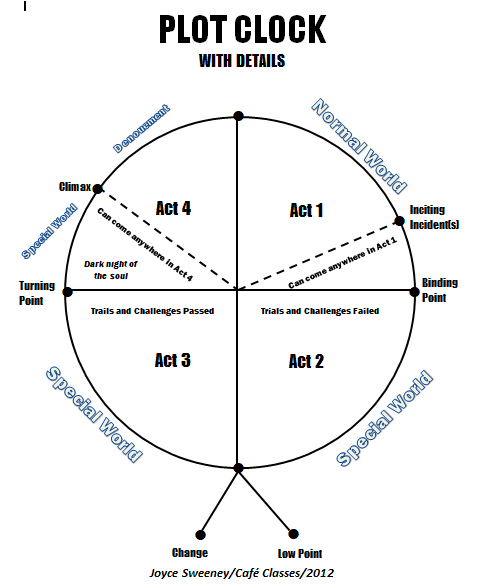 What exactly is the Plot Clock and how was it born?
So the Plot Clock is a Template I started developing in the 80’s when I was asked to write a screenplay adaptation of one of my novels. I read Syd Field’s book Screenplay and said to myself, why do they have a template and we stumble around in the dark? So I started pulling elements of that book into a template to use for myself and to teach from. But parts were missing. When I partnered with Jamie Morris (Woodstream Writers) to do workshops together, we started diving into the old Plot Clock and developed the Plot Clock you see today. Our main thing is that unlike a three-act structure, we believe in a four act structure which gives the MC more time to develop and grow and bond with the reader through their struggles. We are currently working with another writer, Tia Levings, to develop a non-fiction book that explains the Plot Clock in great depth. (Expected to release in April of this year)
How did you come to develop it for picture books?
So, for the Plot Clock for Picture Books, I sort of pushed that thought to the side until I was teaching a plotting workshop in Tampa and Rob Sanders asked me, would the plot clock work for picture books? My answer was, yessss, sort of, for certain ones. Both of our brains started firing and on every break during the day, Rob and I huddled, talking about picture books, reading picture books together and finding the plot points of The Plot Clock in some books but not others. When we found a perfect Plot Clock in Chicken Dance, we said, Eureka! The picture book writers who sense this type of plot template are the best sellers! I think Rob’s track records shows he took this insight to heart.
Are there different rules for picture books when using the Plot Clock?
Yes there are different rules for sure. For one thing, The Plot Clock is for story picture books. Obviously an alphabet book does not need a low point (or does it?) But mostly this is for PB writers crafting stories. One thing Rob and I discovered right away was that a plot point can be carried by an illustration only. So the pictures and words work together to hit all the points. Another thing I’ve seen is that the fiction books that are well-crafted seem to have all four acts almost equal. Not so for picture books. Sometimes act one is almost the whole book, sometimes act 4, there’s no telling. The only rule for excellence is to hit all the points and don’t forget Act 3 like many fiction writers do!
What are some books that you feel utilize the Plot Clock exceptionally well?
I’ll give one shining example of each.
Picture Book – Chicken Dance, by Tammi Saur, illustrated by Dan Santat (now mind you, Tammi Saur never studied or probably even heard of my template…but the template reflects, I believe an intrinsic sense of how the emotional turns of a story should go. She nails it.
Middle Grade – Night of the Living Cuddle Bunnies by Jonathan Rosen. Jonathan is my student so he does know the plot clock, but he was also a ‘natural plotter’ even before then. He writes great MG humor, but the emotional power of the story is just as strong as the laughs, because he hits all the points perfectly.
Young Adult – The Secrets We Bury by Stacie Ramey. Stacie is also my student and like me, she’s a ‘character’ writer more than a plotter, so the plot clock helps both of us remember to ‘have stuff happen’. In this novel, she nails it and especially delivers a powerful and redemptive climax, that’s earned by all the points which come before.
You have an upcoming Plock Clock webinar, correct?
Yes we have a live webinar on Wednesday, January 30th at 7pm (hour long) which will go into depth on The Plot Clock for Picture Books using the template and also some examples from published books. I’ve also seen that this presentation works for any fiction writer, because a PB is such a clear, simple story, it’s easier to understand how the plot points fall. Participants live can type in questions that I will answer on the spot. It will also be recorded so if you can’t make the Live you can watch it On Demand. To sign up, go to http://www.sweeneywritingcoach.com.
Overall, what can writers expect to take away from participating in the Plot Clock webinar?
So far, every time I present on The Plot Clock in any form, people re-examine their own work and realize a point that is missing or needs to be fortified, so it will get your brain working, trust me.
Do you offer any other services that dive into the Plot Clock in greater depth?
Yes, there are lots of ways to work with me, on plotting, or on any other aspect of writing. At Sweeney Writing Coach, we have ten-week live classes, where students watch a video class each week and interact with me and other students on the website in our Forum. These are on various topics of craft. Coming up in February we have Mystery and Suspense. This summer it will be Fiction Writing Essentials and this fall, we’re trying a new concept, which will be a highly interactive, workshop on all the tools of marketing ones fiction: from pitch to query to synopsis to social media posts. Students will work with me to write, rewrite and hone all those things we hate to write but need to have! In addition to the classes we have three live webinars per year. You can buy any class or webinar On Demand (you get the lessons just not interactive) or you can buy an All Access Pass, which gives you free access for a year to anything on the website (which is a considerable amount at this point).
I also critique manuscripts and anyone who would like that service should email me at mailto:grackle@bellsouth.net. Or you can book a phone or Skype consultation. And as I said, coming in April, the Plot Clock Book!
I have to ask… I’ve heard you give “magic beans” to all the writers you’ve helped who have attained agents and publication. I’ve even heard mention of a shaking rattle. Can you explain how this was born, what it symbolizes, and how exactly it works?
The Magic Bean ceremony was something I created way back when I was leading in-person workshops in Fort Lauderdale. One year in with my hand-picked group, and someone got traditionally published! The following year, two more! I was kind of blown away. The next year, I was up to seven (including well known children’s authors Alex Flinn and Sherri Winston) and I said, hey, these people need some kind of prize or ceremony or something! Around the same time, a friend had vacationed in Costa Rica and she came back with these beautiful seed pods. We broke them open and the seeds inside were so beautiful I decided that was my prize. Sherri actually called them ‘magic beans’ but how perfect is that? So we created a ritual, where I give the magic bean to the person. A few things grew up around it, like the rattle (if you get a bean you pick someone to shake the rattle and it gives them luck, like catching the bridal bouquet) and there’s a special necklace where I keep the magic beans, etc. Mostly it is just something to give the writer a sense that yes, they have accomplished something special, because they have. Years of hard work always go into being eligible for that little one-minute ritual!
Thanks for your time, Joyce!
Sorry, the comment form is closed at this time.