

September 27, 2019 THE PASSOVER MOUSE: Cover Reveal, Interview, & Giveaway
About Joy:

JOY NELKIN WIEDER is an author and illustrator with several children’s books to her name. Joy is thrilled to have her debut picture book The Passover Mouse published by Doubleday Books for Young Readers with illustrations by Shahar Kober, a wonderful Israeli artist. The Passover Mouse was awarded the SCBWI/PJ Library Jewish Stories Award in 2018 and was chosen as a PJ Library selection. Joy is also a freelance writer and an educator, and she loves teaching creative writing to students in fourth to sixth grade. She has a small business called Joyously Yours Custom Invitations creating unique invitations for weddings and bar/bat mitzvahs. Joy is also a watercolor artist and loves painting en plein air in far-off locations, like Giverny, Tuscany and Lake Como. She and her husband live in Massachusetts and have three grown children.
Connect with Joy:
Website
Perfect2020PBs
Twitter
Facebook
Instagram
Goodreads
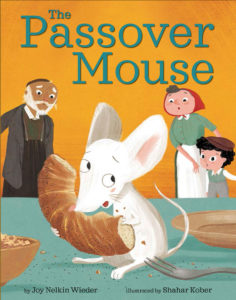 Joy is offering one lucky winner a signed copy of the book upon publication January 28, 2020. To more details and to enter, check out the giveaway below the interview!
Without further ado, I’m honored to reveal with Joy, the cover of her upcoming picture book, THE PASSOVER MOUSE!
JUSTIN: Joy, would you tell us a bit about THE PASSOVER MOUSE?
JOY: The Passover Mouse is the story of a mouse who creates chaos in a quiet little village after the villagers have made pain-staking preparations for Passover. By Jewish law, all leavened bread, or chometz, must be removed from one’s home before Passover with a final search the night before the holiday. After weeks of sweeping, cleaning, and searching her home, a lonely widow named Rivkah piles the last of her chometz on the kitchen table. Suddenly, a little white mouse steals a piece of bread from the pile and goes tearing through the town. The villagers aren’t sure if they need to search for chometz again and even the rabbi doesn’t know the answer. But if they work together, they can get the search done in time for Seder and save Passover.
JUSTIN: Please take us through the process and timeline for your book, from idea inception to publication.
JOY: I hope you have a few minutes, because this book has a long timeline – eighteen years from conception to publication. Eighteen is a special number in the Jewish religion because it means “life” and my picture book will finally have life after 18 years!
I was inspired to write the story while I was doing research for another book in 2002 and came across an interesting passage in the Talmud, which is a collection of Jewish laws with commentaries by ancient rabbis. It won Best Picture Book Text at the Jewish Children’s Bookfest Writing Contest in 2004. The prize included consideration for publication by two Jewish publishers and two mainstream publishers. I thought I was on my way to publication, but they all turned it down. I was crushed by the rejection and heartbroken that The Passover Mouse may never become fully realized. I put the file folders full of revisions and the completed picture book dummy in a plastic bin in the basement where it stayed for many years. Then I heard about an award co-sponsored by SCBWI and PJ Library for Jewish stories in 2018. I dusted off my manuscript and sent it in with no expectations. When I got the email that it won Honorable Mention, I burst into tears!
With award in hand, I sent it off to an agency and landed my wonderful agent Barbara Krasner at Olswanger Literary. Now, we could submit to publishers who only accept agented work and it was accepted by the fabulous Frances Gilbert, Editor-in-Chief at Doubleday Books for Young Readers. For me, the moral of the story is summed up by the former Chief of the Cherokee Nation Wilma Mankiller: “The secret of our success is that we never, never give up.”
JUSTIN: I learned that this story is based off a story from the Talmud. Would you explain the Talmud to us and what inspired you to base your story off one of its stories?
JOY: The Talmud is the body of Jewish law with commentaries about the law by ancient rabbis. In the tractate discussing all the laws and rituals of Passover, I came across a discussion by the rabbis about the possibility of a mouse bringing bread into a house that had already been searched for chometz. They wondered if the house would have to be searched again and came up with several scenarios – what if a mouse with a piece of bread went into a house, but a different mouse came out of the house carrying a piece of bread? Is the second mouse is carrying the same piece of bread or a different piece? The rabbis went around and around the issue, but in the end, they never made a decision. I was in shock! How could the rabbis take so much time to discuss an issue and then leave the question unanswered? I knew I had to come up with an answer and finally solve the ancient conundrum.
JUSTIN: What were some of the challenges, if any, you faced using an existing story as inspiration for yours?
JOY: As I was reading the passage, I could imagine the bread-loving mice running in and out of the homes of a Jewish village, or shtetl, and creating havoc. But the ending wasn’t decided in the original text, so I had to frame the story and come up with a conclusion. I decided the main character would be a lonely widow who had no one to help her with all her Passover preparations, and the true conflict of the story would be her longing for connection to her community. However, children’s stories need to be solved by a child and not an adult, so I included the rabbi’s son Menachim to help Rivkah chase the mice through the town. Menachim is the clever boy who realizes that if everyone pitches in then the work of searching all the homes again will be done in no time. Rivkah finally has helpers to finish her Passover preparations, and she invites them to stay for Seder, filling her once lonely home with new-found friends.
JUSTIN: Do you have any advice, tips, or tricks for taking a classic story and giving it a modern twist?
JOY: That’s a great question! In this case, the original text was a discussion and not a narrative, so I had lots of leeway to create something new. I wanted it to have the feel of a traditional folktale but be an original story. My pitch for the concept is The Gingerbread Man meets Fiddler on the Roof. Combining two different ideas – chasing a mischievous character through a town with a formula of adding more and more pursuers, but setting it in a Jewish shtetl allowed me to take an old story and make it new.
JUSTIN: You mentioned in a previous interview an organization called PJ Library and stated they helped you open the door to landing an agent and signing a contract with an editor. Would you talk more about this organization and how they played a role in your journey?
JOY: PJ Library is a wonderful non-profit organization that sends free books that celebrate Jewish values and culture to families with children 6 months to 8 years old. Any family that signs up for the program at https://pjlibrary.org/ will be sent FREE Jewish children’s books each month. The program started in Western Massachusetts and was so successful that it went national, and now it is a global phenomenon. In North America alone there are more than 180,000 participants in the program. It is very exciting to have The Passover Mouse become a PJ Library selection and get into the hands of so many children.
Because of the honorable mention for the SCBWI/PJ Library Jewish Stories Award, I was able to let agents and editors know that PJ Library was interested in my manuscript. Knowing there was a built-in market for my book helped me win over my agent, and she helped me find my editor.
Prior to PJ Library, the Jewish children’s book market was very small, and it was difficult to get Jewish stories published. Because of the demand that PJ Library has created for quality Jewish children’s books, the market has greatly expanded for creators of Jewish children’s content –including middle grade novels due to PJ Library’s new program for older kids called PJ Our Way.
JUSTIN: You worked with editor, Frances Gilbert (who is AWESOME) on this book. Would you tell us a bit about what it was like working with Frances?
JOY: Working with Frances has been a dream. She pushed me to make the story stronger, and she accepted my suggestions for changes as well. I also have to put in a plug for my amazing copy editor at Doubleday, Jenny Golub, who found a few errors in halacha (Jewish law), such as the citation for the Talmudic passage. I feel more secure putting my book out into the world knowing that it has been edited and copy-edited with such integrity and talent.
JUSTIN: I see an illustrator (Shahar Kober) was brought on board for this book. Who makes that decision to have an illustrator collaborate on your book with you when you yourself are an author-illustrator? And what factors play into that decision?
JOY: I had included a complete dummy and sample illustration when I submitted my manuscript. But my editor, Frances Gilbert, thought my illustrations were old-fashioned and wanted to find another illustrator. Once I removed the knife from my heart, I knew I had to let that piece go in order to have my book published by Doubleday/Random House – one of the Big Five publishers! Ever since winning the award from SCBWI/PJ Library, my new motto had been: Trust the Process. So, I had to trust that Frances knew the market and would choose the best illustrator for my book to do well.
JUSTIN: Backtracking a bit, Frances shared that it was important to her that your illustrator be Jewish so that they capture the cultural details perfectly. Was this goal/plan something you were privy to when your book was acquired? Did you have a say in it?
JOY: Frances mentioned that she wanted to find a Jewish illustrator, and I agreed that a Jewish illustrator would understand all the intricacies and laws of Passover. However, Frances still asked me to review the illustrations to make sure all the details were correct, such as the ceremonial items shown on the Seder plate. One interesting cultural misconception was regarding the four cups of wine. Frances thought it was four physical cups on the Seder table, regardless of the number of guests, but I let her know that every guest has a wine cup which gets filled four times throughout the course of the Seder. She thought that looked a little “boozy” for a children’s book, so we compromised and had some of the guests’ wine cups set behind other guests at the table.
At the beginning of the process, I asked if I could suggest illustrators, and Frances was gracious about accepting my input. I sent her a list of my top five, and she had one of the same illustrators on her short list, too, which made me feel that we were on the same page. She ultimately chose someone else, but I felt that I was part of the process, which is not always the case for an author.
In the end, Shahar did a wonderful job in making all the various characters in the village – both human and animal – come alive in a fun and original way.
WILDCARD QUESTION:
JUSTIN: What has taken you the longest to get good or decent at?
JOY: Watercolor is a very tricky medium, and it has taken me years to master it – and I’m still working on it! I use watercolor in my illustrations, but I also love landscape painting, especially outdoors. I’m passionate about plein air painting, and I’ve taken many classes and workshops in amazing locales, such as Monhegan Island in Maine, Monet’s Garden in Giverny, and the gardens at Villa Monastero in Varenna, Italy, on the shore of Lake Como.
JUSTIN: Thanks for your time, Joy!
JOY: Thank you, Justin! You do so much for the kidlit community, and we truly appreciate it J
THE PASSOVER MOUSE is available for pre-order through Amazon:
Sorry, the comment form is closed at this time.