

January 13, 2020 Interview with Author Dr. Virginia Loh-Hagan
I’m excited to welcome to the blog this week, author Virginia Loh-Hagan!
*Virginia is offering one lucky winner a copy of NIAN, THE CHINESE NEW YEAR DRAGON. To enter, check out the Rafflecopter giveaway following the interview below.
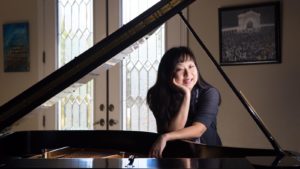 About Virginia:
Dr. Virginia Loh-Hagan is an author, university faculty member, and former K-8 teacher. She’s currently directing the Liberal Studies program at San Diego State University. She writes books about things that geek her. She especially likes to write about her Chinese-American heritage. After all, she was born on Flag Day in the Year of the Dragon. She’s also interested in writing fun facts about monsters, weird bodily noises, urban legends, hot dogs, and anything on the odd side. She lives in northern San Diego with two non-trained naughty dogs and one semi-well-trained husband. Learn more about her at www.virginialoh.com.
Connect with Virginia:
Website
Twitter
Facebook
Goodreads
Let’s kick off this interview with a game – Two Truths and a Lie. (The truth is listed right above the giveaway link following the interview below.)
#1. I got married on 10-10-10 at a Costco food court. – I wanted to. My husband wouldn’t let me. So, my girlfriends threw me a surprise bridal shower at a Costco food court instead. (We got married at Encinitas Library.)
#2. I have four pianos including a Steinway semi-concert. – I would love to buy another piano but my husband is drawing the line.
#3. I studied German for five years in junior and high school because I was/am obsessed with “The Sound of Music.” – I went to Salzburg and did the “Sound of Music” tour, one of my favorite things!
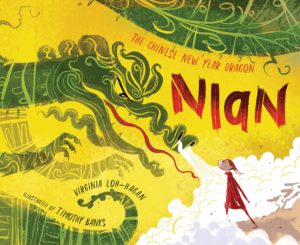 Would you tell us a bit about your recently released picture book, NIAN, THE CHINESE NEW YEAR DRAGON.
Mei hates springtime. Why? Because it’s only in the spring that Nian, a fierce dragon, is able to leave his mountain prison under the sea to terrorize the local village. When the villagers hear the rumblings of Nian’s hungry stomach, they know that winter has ended and spring is coming. But this year on the night before the first day of spring, a magical warrior visits Mei in her dreams. He tells Mei that it is her destiny to face and defeat Nian. But she must do it within 15 days or the dragon will be free forever. This is a retelling of the Nian legend with an original twist (girl power!), while explaining the origins of Chinese New Year traditions.
Who might this story appeal to?
This story would appeal to anyone who wants to learn more about Chinese New Year or who likes dragons or who likes folktales or who like girl heroines or who likes…. The target audience would be elementary school-aged children; but, I hope folks of all ages will love it.
What was the timeline like for NIAN, from your inception of the idea to acquisition to publication?
Once Sleeping Bear acquired it, it probably took about two years. It takes awhile to revise the text and get the illustrations completed. You’re never done until you’re done. There’s always something to do.
Who were the team members you worked with on it and what was the process like collaborating with them?
Writing picture books is definitely a team effort. First, much credit goes to my editor at Sleeping Bear Press who is my biggest champion. An editor is a writer’s key to success. My editor helped make my story better; she also stewarded the book through the publication process. Second, there’s the illustrator. Timothy Banks was the perfect person to illustrate this book. I love, love, love his visual interpretations of my story. He nailed it. He brought my words to life. Third, there’s the whole Sleeping Bear Team including designers, marketing, copyeditors, etc. It takes a village to get a book out there into the world. And, I feel very lucky to have the best people in my village!
What is it about the legend and your story that speaks to you most?
I love dragons. I love monsters. I love folktales, myths, and urban legends. I love the mix of reality and fantasy. Our minds are mired in stories; our cultural narratives are founded upon them. I love this idea that we have two ways of explaining the unexplainable in this world: science and stories.
What inspired you to put a fresh twist on the legend? In the original legend, NIAN is a beast with sharp teeth and horns. But in your story, he’s a dragon. Did you make that change to avoid scaring young readers, or was there another motive behind it? Perhaps the year you were born?
I knew that I wanted a girl heroine so that was easy. Girls are more than capable of slaying dragons and saving the day! I also changed Nian the monster into a dragon because I love dragons (According to Chinese zodiac, I’m a Fire Dragon) – I also wanted to add a pourquoi element in showing how Mei tamed the dragon to become a lucky symbol. In addition, I wanted to include the “magic three” element of fairy tales by including three ways that Mei saved the village; of course, these three elements explain three popular Chinese New Year traditions.
What was the process like of crafting your main character Mei and inserting her into this retelling?
The process was pretty easy – It was natural, not forced. It just worked. This is the best way to write a story. The hardest part was figuring out her name; I just used a derivative of my own Chinese name, which is “Shin Mui.” My Chinese name means, “beautiful little heart.”
Is there a specific part of the story and/or spread that you like most, and why?
There are so many images that I love but my favorite is the scene in which the villagers hung the red banners. The contrast of the dark makes the red colors pop out. (Red is my favorite color – I happen to look good in red!)
Structurally, how did you approach telling this story during the drafting process?
Writing picture books is definitely a challenge – you have to develop plot and character in so many words. One of the things that I keep in mind is that an illustrator can help tell the story. This way, I can save words. I also have to make sure that the story moves as you can’t have five spreads in the same scene. This is why it’s important to map out your story and why revising and re-writing are so important. It takes a lot more work to say more with less. Another tip is to consider what’s important versus what’s interesting. You have to be willing to cut text.
What are some of the challenges you faced bringing a longstanding legend of epic proportion to the picture book format?
The main challenge is how it will be received. If people only see a story in one way, then it’s hard to accept a different version. But, I argue that stories, like memories, change every time they are recalled. I also argue that there are many different ways to tell the same story. For example, how many books about Abraham Lincoln are out there? How many versions of boy-meets-girl are out there? All stories share universal themes. There’s lots of room for stories – the key is to keep the angles and perspectives fresh.
I learned via your recent podcast interview with Gabriella Pereira (https://diymfa.com/podcast/episode-284-virginia-loh-hagan) that your dissertation was a qualitative study on the cultural authenticity of Asian-American children’s literature. How does this background affect your own writing process for stories like NIAN that draw from your heritage?
It makes me more aware of the importance of representation. It also kept me abreast of the Asian-American kidlit community. For my dissertation, I had to read a lot of books in order to assess the cultural authenticity. (What I was really trying to do was come up with a heuristic to evaluate cultural authenticity, but this is difficult to do without an insider perspective.) Reading is an important part of writing – Writers have to be readers. They have to know what’s out there. They have to build from mentor texts.
In regard to my heritage, writing about Asian-American themes also helps me to examine my own heritage. I can relate to immigration stories but at the same time, I’m also very “American” in many ways. In today’s world, identities seem to be more fluid – I think this also applies to culture/ethnicity. In every story, we should be able to see similarities and learn about differences. No one story is going to be 100% representative but we can aim to be authentic.
Do you have any actionable advice for ownvoices writers who might be concerned about how to maintain the authenticity of their heritage, especially those who might be tackling a retelling of a legend and facing concern over distilling it for the picture book format and today’s readers?
It’s important to do your research. It’s also important to be able to justify all your writing decisions. Like all things, be fair and informed.
What was the research process like for this story?
This is a great companion book to POPO’S LUCKY CHINESE NEW YEAR. In fact, I discovered this folktale while researching POPO. (The stories are very different in that one is more light and whimsical and the other is more dark and edgy. But, I like to think that both stories feature smart, sassy, spunky girl protagonists.) While researching Chinese New Year traditions, I saved this folktale (and others) to explore further. Kathleen Krull, my author-pal and nonfiction biographer extraordinaire, describes story research as a “rabbit hole.” You can really get lost in all the fun facts. As a writer, you have to make decisions about which bits are useful to your story.
How does your work as an educator and curriculum designer influence your writing process, the stories you put into the world, and the way in which you connect with other creators, educators, librarians, and readers (young and “old” alike)?
Honestly, what really inspired me to write children’s books were my elementary students. Before teaching at San Diego State University, I taught elementary school for about a decade. I write books that I would’ve wanted for my curriculum. I write books that I would’ve used in my own classroom. I write books that I would’ve wanted to read as a young reader.
I like to think that teachers, librarians, and writers are “my people.” It does make it easier that I’m able to speak the same language and understand the codes. It’s been a blessing to belong to the kidlit-community-at-large which includes readers, writers, educators, librarians, publishers, etc.
Thanks for your time, Virginia!
Sorry, the comment form is closed at this time.