

February 5, 2020 Interview and Giveaway with Sarah Floyd
I’m excited to welcome to the blog this week, author Sarah Floyd!
* Sarah is offering one lucky winner a signed copy of TEN CLEVER NINJAS or a pb manuscript critique – winner’s choice. To enter, check out the Rafflecopter giveaway following the interview below.
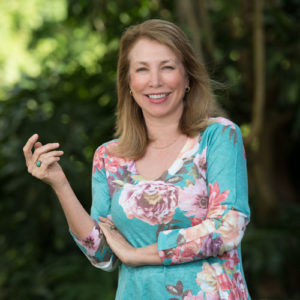
About Sarah:
Sarah Floyd was born in Carmel Highlands, California, where she and her friends explored, climbed trees, and built forts in the woods that surrounded their homes—much like the characters in her picture book, Ten Clever Ninjas. When she was in first grade her family moved to San Francisco, and then to Kuala Lumpur, Malaysia. She always brought her favorite books, wherever she moved, and she always found new friends who loved to read. Now she writes books for children and teens—for her, it’s the best job in the world!
Sarah is also the author of the middle grade novel, Butterfly Girl, and is an active member of the Society of Children’s Book Writers and Illustrators. She lives in Florida with her husband and teenage son, a green belt in Taekwondo.
Connect with Sarah:
Please tell us a bit about your debut picture book, TEN CLEVER NINJAS
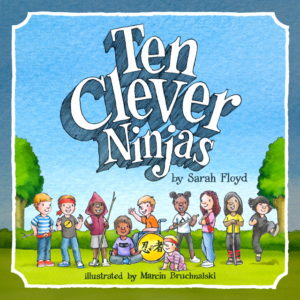
Ten Clever Ninjas is a counting story that features a diverse cast of characters, martial arts, and cupcakes! Here is the official blurb from the back of the book:
A very clever ninja and his nine ninja buddies spar across the countryside, build a secret hideout, and follow their inner Zen to discover a sweet cupcake surprise. Ki-ya!
Who might this story appeal to?
This story will appeal to boys and girls ages 2-5, along with their caregivers, teachers, and librarians. There’s a counting element woven through the story, which includes the principle of “+ 1” as each new ninja joins the fun.
What inspired you to write it?
As a little boy, my son was fascinated with martial arts and all things “ninja.” He practiced Taekwondo at our neighborhood dojo and competed in several tournaments. On the weekends, he and his friends played elaborate ninja-spy games, using bits and pieces of fabric to tie headbands and armbands, much like the ninja friends in Ten Clever Ninjas.
What was the timeline like for this story, from your inception of the idea to publication?
I was a volunteer reading coach at my local public school, and while walking home after tutoring a group of kindergartners, the concept snuck up and grabbed me, fast—faster than anything I have worked on in the past. I had been thinking about the days when my son was a kindergartner at that same school, when he and his ninja-buddies would crowd around our kitchen table, hungry after a long afternoon of ninja fun . . .
. . . and then with the magic that happens when a book first grabs hold and begins to emerge, the first stanza revealed itself, along with the overall story structure. Then the rhyme clicked in, and I ran all the way home, repeating that first stanza again and again before the words slipped away. I created a rough draft over the course of a few hours. I worked on it for several weeks, refining the story and meter, and then sent it off to my CPs for their feedback.
Publication took much longer . . . about two years from submission to publication.
Who were the team members you worked with on it and what was the process like collaborating with them?
I am blessed with brilliant CPs who are exceptionally gifted in writing rhyme: my agency sister Julie Abery, and long-time critique partners Sharon Chriscoe and Jess Shaw. I learned so much from them while drafting this book. Once the manuscript was fully polished, my agent, the amazing Essie White of Storm Literary, began submitting it. The editor who fell in love with the story was Callie Metler-Smith at Clear Fork Publishing, who provided helpful feedback too.
One of the joys of working with Clear Fork has been the transparency and sense of collaboration: Callie encouraged me to communicate directly with the illustrator, Marcin Bruchnalski, to brainstorm ideas about how the art could best support the story. Before becoming a fine artist, Marcin had gone to medical school to become a doctor—his earlier training is clear in the way he’s able to capture movement and emotion. His art is both realistic and playful, a perfect fit for Ten Clever Ninjas.
To sidetrack a moment, I see that your debut novel, Butterfly Girl, was also acquired and published by Clear Fork Publishing. How did that come about?
Ten Clever Ninjas was acquired first, and Butterfly Girl followed.
Butterfly Girl and I have had a long journey together—it’s the first book I ever wrote, and was the book that attracted my first agent, Danielle Smith (a few years before she exited the business, but we never submitted to editors, long story ) . . . and finally Butterfly Girl along with my picture books helped me sign with my wonderful agent, Essie White. She had been submitting it for a while, and at that point we were in serious talks with Callie Metler-Smith at Clear Fork Publishing, about Ten Clever Ninjas. I felt at ease with Callie, and confident about the press, and knew she would do a great job bringing Butterfly Girl to life.
Working with Callie and her team at Clear Fork has been a wonderful experience! After writing a second stand-alone MG novel (currently on submission), I asked Callie if I could re-read Butterfly Girl before publication to see if anything I had learned might apply. Re-reading ended with me sending her some “Before and After” excerpts to show how I would like to revise to elevate the writing while keeping the content intact. She agreed with my plan, and we pushed back the release date to give me the time I needed. I’m grateful to have landed with such a collaborative and supportive publisher.
What came first, picture books or middle grade?
Picture books! Butterfly Girl started as a picture book, and after querying it for several months, the idea developed into a three-book series: Butterfly Girl, Butterfly Girl Goes to School, and Butterfly Girl and Friends.
I polished all three books and began querying the series, and thankfully after nothing but crickets and polite passes, one of the agents responded with a kind and thoughtful rejection, and suggested I might have an interesting voice for MG . . . I decided to give it a try, and picked up a few books at the library about novel structure and craft, which helped me recognize that my PB series had a story arc that could be aged upward (with a backstory and other elements) to create an MG novel. A few months later, the first draft of Butterfly Girl was born.
How, if at all, has writing for one of these audiences influenced your writing process for the other?
Writing picture books has helped me establish the main structure for novels too, since picture books need a clear arc and strong turning points, a condensed version of a novel’s “beats.”
While reading the reviews of your picture book, one word popped up several times: Diverse. Would you tell us more about your characters and how they developed into this inclusive ensemble?
I was a kindergarten reading coach at my son’s public elementary school for many years (and still volunteer there from time to time). We live in Florida, which has a diverse population and also attracts new residents from all over the world, but I had a difficult time finding picture books, especially fiction, that featured non-white characters.
It felt unfair to me. Many of my students did not have a chance to immerse in books where they could see themselves reflected in the characters. In early talks about the book with my editor, I specifically requested a multi-cultural cast of characters, and she agreed with that vision.
Why did you decide to write this story in rhyme and how do you think it serves the story?
The story came to me in rhyme, although it took quite a while to fully smooth out the meter (writing in rhyme is fun, but challenging!) I enjoyed reading rhyming books aloud to my son when he was little, and kids catch on to rhyme early and can “read along” at a very young age, which makes rhyming stories perfect for preschoolers.
Is there a specific part of the story and/or spread that you connect with most, and why?
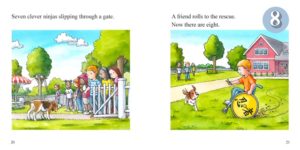
I love the scene where Ninja #8 rolls to the rescue in his wheelchair. That character was inspired by my friend Peter, who was born with Duchenne muscular dystrophy. Peter was super smart, and full of energy and humor, even when his body began to fail him. He died when he was fifteen. I keep a picture of us as kids, displayed on my bookshelf.
Is there anything you’re currently working on and would like to share with us?
I’m working on a slightly subversive picture book idea, with a similar vibe to Jon Klassen’s brilliant I Want My Hat Back, but my book has no hats, and no one gets eaten. : )
What advice would you give writers who have not signed with an agent or published a book yet?
Don’t fall into the trap of comparing your journey with anyone else’s. Keep studying craft and connect with other writers to exchange critiques and provide support for each other. I’m convinced that perseverance is the secret ingredient that turns writers into authors.
Thanks for your time, Sarah!
Thank you, Justin! And thanks for all you do to support the kidlit community!
Sorry, the comment form is closed at this time.