

July 13, 2020 Interview and Giveaway with Kjersten Hayes
I’m excited to welcome to the blog this week, author Kjersten Hayes!
* Kjersten is offering one lucky winner a picture book critique. To enter, check out the Rafflecopter giveaway following the interview below.
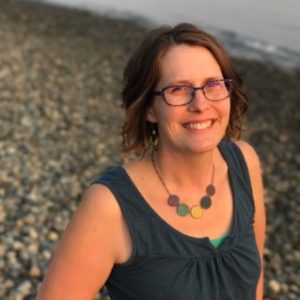 About Kjersten:
Kjersten Hayes lives in Bellingham, Washington, in a century-old house full of color, books, pottery, art, music and happy kid noises. She has spent many years creating and selling collage work, greeting cards, and handmade journals. She loves adventure, making things, and teaching art classes for kids.
Connect with Kjersten:
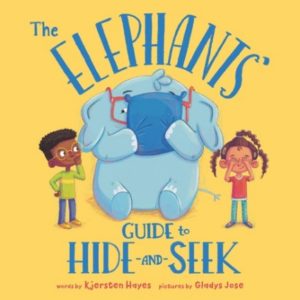
Who might this debut picture book, THE ELEPHANT’S GUIDE TO HIDE-AND-SEEK, appeal to?
It will appeal to young kids who like to laugh, play hide-and-seek, or love elephants. It’s also an especially great read for kids who struggle to fit in.
 What inspired and/or motivated you to write it?
I wrote the first draft for a personal challenge I gave myself to write 5 new picture book manuscript drafts in two weeks. The challenge came about after I got a particularly negative critique for an unrelated project. I decided I wanted to set everything aside and just write for fun. I figured if I wrote fast, I’d force myself to not care about the outcome so much. It worked! It was fun! And ironically, I discovered my writing is better when I stop worrying about what others think of it.
How did you come up with the concept for it?
The original idea came from squishing two ideas together during Tara Lazar’s Storystorm challenge one year. The first idea was to write a parody guidebook. The second idea was a memory I’d jotted down. When my older son was small, we lived in Malaysia, where we learned about, met and fell in love with elephants. One Christmas, home in WA state for a visit, my son looked out the car window and said, “Look mom! A forest! That’s where the elephant’s live!”
Why did you write this particular story in 2nd person pov? And is that the pov you initially began the book with?
The POV is technically 1st person plural speaking 2nd person, so “we” are speaking to “you.” The “we” part of the voice is The Elephant Hobby and Sport League, and the “you” part of the voice is meant to be you, an elephant in need of hide-and-seek advice. Choosing a complicated POV wasn’t intentional at all. I wrote the book completely for fun and didn’t worry about what I was doing when I wrote the first draft. But it is the voice I started with and the voice I finished with. I think I kept the POV despite it being complicated because it was the right POV for this book—a parody guidebook for elephants playing hide-and-seek.
What were the challenges of writing in 2nd person pov?
For a good while, my critique group had a field day with the 1st person plural speaking 2nd person POV. They helped me smooth out many inconsistencies in early drafts. There were a couple of big challenges. Besides the obvious challenge of using 2 unusual POVs both in the same manuscript which probably should have been complicated enough, I also went and made all of the above elephants. That made it weirder and harder to get across right away. Which leads to the biggest challenge of all—nailing all of those complicated choices right up front with the first line or two. It had to be clear right away that “we” were speaking to “you,” and that “you” referred to an elephant. That and just like any other voice in a book, the voice itself had to match the personality of the rest of the book. It had to be funny and charming enough to hook a reader.
I eventually brainstormed 100 different variations for a first sentence. From that brainstorm, the first two sentences finally came together to what they are now: “The game begins, dear elephant. But let us guess…you are the only pachyderm playing.”
I saw you’re also an illustrator. Did you make the decision not to illustrate this book and, if so, why? Was that part of your initial plan?
My initial plan was to illustrate the book myself. I’m a lifelong artist and I definitely wrote the book thinking visually and had pictures in mind as I made it. I also did make a dummy for it. But like many paths to publication, my path has been twisty.
While I made collage for many years and had good feedback on my collage work, somehow by the time my writing caught up, I had shrunk back somewhat with my art (lots of rejection? Not sure why). By then I think I was trying to fit a mold with my art more than I was just being myself. I had started doing a digital version of my collage which just wasn’t as bold or unique. By the time I’d finally found some success with my writing (I won a big SCBWI award and had started getting better feedback from rejections), my art had lost some of its older shine. As my agent and I submitted this book we had a lot of feedback that the story was funny, and people loved it, but the art wasn’t quite matching.
When you hear feedback several times, it’s worth listening to. So when my editor wanted to buy the manuscript but had a different vision for the art—I decided to open my heart to the possibility that I could allow someone else to contribute with a different vision for the art. And I’m so glad I did. I LOVE Gladys Jose’s art. I think it’s a wonderful match for my voice in this book. I’m also a big believer in taking setbacks and turning them into opportunities. In this case, I’ve learned that maybe I have a wider voice with my writing—that I can write things that don’t have to match my art. I also took this as a chance to return to the medium where I feel more at home and more in love—collage. Both my writing and my art have grown stronger as a result. And Gladys and I have this wonderful funny book we both contributed to. So it wasn’t my initial plan to do it this way, but I love the end result and am glad I opened my heart to a different vision.
What do you perceive to be some of the pros and cons of being both the author and illustrator versus wearing one hat?
Because I’m an artist myself, I think visually. So I have a good grasp of what can be said in the pictures that doesn’t need to be said in the words. Also the flip side is true too. Through practice I’ve figured out how words can best add to a visual story. To me this includes things like voice, fun read-aloud language, and areas where the words and pictures play off of one another or say two different things or add to the humor. So even if I’m writing something I wouldn’t illustrate, I’m still thinking like an illustrator. One pro I’ve found working only as a writer is that I don’t have to worry about including something if I don’t like drawing it. For example, I have one manuscript with some deer characters. I don’t think I would have even tried with that idea had I not opened my mind up to the possibility of someone else drawing the pictures because I hate the idea of drawing a bunch of deer.
I’d imagine a book focused on hide-and-seek is heavily dependent on visuals. How did you use art notes within the manuscript?
Even if my editor had a different vision for the art for this book, I think my dummy did help sell the words. It’s easier to picture what those words mean if there are some ideas in pictures. That said, most of my words leave a lot of wide-open ideas about what a picture might be. A sentence like “Think camouflage,” doesn’t really need art notes. I did leave some though. My rule for art notes is make them very brief, only use them if they truly contribute, and be flexible if my agent or editor wants to get rid of them. For me I mostly keep them only when the words and art say something different and it’s unclear or confusing without a note.
If you had to select on or two words as the takeaway for this book, what words would you choose?
Playful! Funny!
What’s the most exciting part of the publication process to you?
I’m most excited to someday share this book with real kids in person when quarantine days are over. I love teaching and can’t wait to do school visits.
Is there anything you’re currently working on and would like to share with us?
While I’ve got a lot of pieces I’m excited about right now I’m especially psyched for one I’m revising with a funny, unexpected rhyme scheme. Like my elephant book I made things delightfully complicated but I’m loving how it’s coming together. Hope I get to share it someday before long!
Thanks for your time, Kjersten!
Sorry, the comment form is closed at this time.