

February 13, 2020 Interview and Giveaway with Shannon Stocker
I’m excited to welcome to the blog this week, author Shannon Stocker!
* Shannon is offering one lucky winner a picture book manuscript critique. To enter, check out the Rafflecopter giveaway following the interview below.
ABOUT SHANNON:
 Shannon Stocker is an award-winning author and proud word nerd who lives in Louisville, KY, with her husband, Greg, and their children, Cassidy and Tye. Her debut picture book, CAN U SAVE THE DAY (Sleeping Bear Press), released in 2019, her nonfiction PB bio about Evelyn Glennie entitled LISTEN: HOW ONE DEAF GIRL CHANGED PERCUSSION comes out with Dial (Penguin/Random House) in 2022, and several of Shannon’s nonfiction essays have been published in Chicken Soup for the Soul. Shannon currently serves as SCBWI social co-director for Louisville, a judge for Rate Your Story, and she created the blog series, Pivotal Moments: inHERview, highlighting transitional life stories of female picture book authors. Cool facts: Currently writing her memoir, Shannon is a medical school graduate, a coma survivor, an RSD/CRPS patient and advocate, and a singer/songwriter who once performed two songs, including one original, as part of an opening act for Blake Shelton. Shannon is represented by Allison Remcheck of Stimola Literary Studio.
CONNECT WITH SHANNON:
Website/blog
Facebook
Author FB
Twitter
Instagram
Goodreads
Watch the music video
Thank you for joining me today, Shannon!
SHANNON: And thank you for having me! I’m grateful.
JUSTIN: Okay, let’s dive in! Please tell us a bit about your recent picture book debut, CAN YOU SAVE THE DAY?.
SHANNON: CAN U SAVE THE DAY was so much fun to write! I’ve always loved playing with words, alphabet books, and animals…so this was a pretty natural direction for me. This book takes 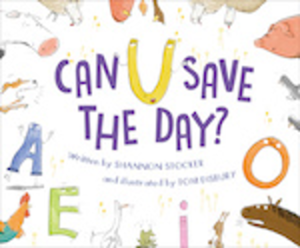 place on a farm. When the consonants pick on the vowels, they leave the manuscript one by one. As they do, they also leave the dialogue in the book…so, for example, “Instead of ‘bark,’ the dog said ‘brk.’” Once A, E, I, and O have taken off, a sleeping tractor plows toward the unaware consonants, unable to honk, and U must figure out how to save the day.
JUSTIN: Would you take us through the process and timeline for CAN U SAVE THE DAY?, from idea inception to publication.
SHANNON: This idea came to me in those moments before you drift off to sleep. I couldn’t shake it, so I popped out of bed and wrote into the wee hours of morning. I got a few hours of sleep, drove my kids to school the next day, then continued writing. By early that afternoon, I’d completed my first horrible draft. I was relatively new to picture book writing at that time (this was only my second manuscript), but I knew enough to know the first draft was weak. I met a seasoned writer by the name of Jack Dennis who really mentored me. I’d consider him my first real critique partner, I think. Eventually, he helped me get the manuscript to a point where I felt comfortable querying it. I got a few nibbles, took a few online classes, and kept writing. After a few months, an editor requested an R&R. I made revisions, she requested more, and it climbed the chain to Acquisitions…then was rejected. It broke my heart. But I kept doing my thing, writing, revising, critiquing, meeting people through 12×12 and SCBWI, and eventually got a critique from Sarah Rockett at Sleeping Bear Press. She requested revisions a few times and I worked hard to revise to her specifications while remaining true to my vision of the story. In the end, they obviously acquired the book! I talk more about working with Sarah in another answer. But I also want to mention that I’m a songwriter so instead of a book trailer, I decided to write a song and make a music video to go with CAN U SAVE THE DAY. My brother-in-law, Mark Stocker, does fabulous production work, and the kids in the video really make it shine. Here’s the link, if you want to check that out

JUSTIN: What were some of the greatest challenges you faced during the creative process for this particular story?
SHANNON: I think my biggest challenge has always been believing in myself. It’s so easy to have imposter’s syndrome in this industry. Many editors aren’t crazy about rhyme and suggested I write the story in prose, which I tried…but to me, it lost the magic. I think it’s so important to revise when agents and editors ask you to—we need to trust the professionals, check our egos at the door, and be open to constructive criticism at all times. But we also need to honor our vision. It’s a wobbly tightrope.
JUSTIN: What, if any, were the challenges or differences of developing characters who are inanimate objects (letters)?
SHANNON: This is a great question. Some editors say they will not take any stories with anthropomorphic characters, and there’s just no way around that. Same thing with rhyme. So I knew that this book would have a limited list of potential buyers, but I don’t think I realized exactly how limited that list would be! I didn’t feel that writing a book with anthropomorphic characters was any more difficult than writing one with people or animals—my letters have personalities just as people do—but I knew it would be more challenging to illustrate. I really credit Tom Disbury on this front. He did such a fabulous job bringing the letters to life in a simple, adorable way.
JUSTIN: How and when did you know your editor was possibly the right match for your story and it was time to submit your draft to her?
SHANNON: Sleeping Bear publishes a lot of alphabet books, and they aren’t afraid of rhyme. Additionally, they accept unsolicited queries and I was unagented when I sold my debut. I knew it was time to start querying after all my critique partners had read multiple versions of the story and I’d revised it ad nauseum. Since it’s written in verse, I also made sure I had a number of other people read it out loud to me so I could see where the meter broke. I wanted it to be free of all verse traps…close rhymes, Yoda rhymes, broken meter, forced rhymes, etc. And I wanted to be sure I wasn’t sacrificing story for the sake of the verse.
JUSTIN: Do you feel there were any advantages or disadvantages to submitting a manuscript to her she previously critiqued?
SHANNON: Oh, I definitely feel this was a huge advantage! When you go through the slush, you never know if your story will even be read. Sometimes you hear back, sometimes you don’t, and there is no such thing as a definitive timeline. With a paid Skype critique, I not only got immediate feedback, but I could see her face…I knew the parts that clicked and the parts that didn’t by watching her reactions. When our fifteen minutes was over, I took advantage of the chance to ask her if I could resubmit after revising per her specifications. I made sure I addressed every single concern before resubmitting. I wanted her to know that I was amenable to critiques and worked efficiently. It’s just like submitting to an editor you’ve met at an SCBWI conference. A personal connection is always advantageous.
JUSTIN: How much time elapsed from your book’s acquisition to your Publisher’s Marketplace announcement?
SHANNON: I had to look back to remember! I found out the book was going to the final Acquisitions meeting on 4/28/17, learned they were acquiring it on 5/30/17, and it was announced in PM on 8/2517. Considering I’ve had another manuscript in Acquisitions for a year now, that’s actually pretty quick!
JUSTIN: Do you have any tips or tricks for authors going into [or who will one day go into] the editorial process?
SHANNON: Trust your editor, but also speak your heart. You want to be respectful without losing your vision. If you broach your concerns thoughtfully, you’re more likely to be heard. But you don’t want to keep quiet and then regret saying nothing later. This is your book…your baby. It’s so hard to get published. Once you do, be sure you’re putting something into the world that you love!
JUSTIN: What was your greatest takeaway from acquisitions and/or editorial process?
SHANNON: It takes so much time and patience. Once you’re “in the system,” do your best to let it go and just WRITE! Once your book comes out, the process of marketing is so time-intensive that you may find you crave/miss writing time. I also think a huge takeaway for me was how fortunate I’ve been to have the editors I’ve had. I know a number of people who have walked away from the editorial process frustrated, and this didn’t happen for me. I’ve had two editors at two houses, and I’ve loved them both. I’d work with them both again in a heartbeat. Don’t be afraid to ask experienced authors about their experiences with editors and different houses, because they truly can (and do) vary tremendously.
JUSTIN: So what was it like working with your critique partner/s group during so many stages and iterations of this story? How did you present them with each new draft and previous industry feedback, and how did that influence their critiques and the development of the story?
SHANNON: I’m going to answer this question more about how I work with my CPs now, since I really developed my close-knit groups after this story sold. A few 12×12 CPs helped me with an early version of CAN U SAVE THE DAY, for sure, but I largely revised that particular story with the help of Jack and my editor, Sarah. I honestly believe that I would not be where I am today (published and agented) without my current critique partners, though. I’m in two different online picture book critique groups, both of which work in a similar fashion. In addition to that, I have critique partners that I met through SCBWI conferences whom I can use for specific styles – one group is for nonfiction only, for example, and another group really helps me with my memoir. The picture book groups are filled with people I met through 12×12, online courses, SCBWI, and/or networking. Most are published and/or agented, and they all blow me away with their writing. For the most part, we have a rule that you can post whenever you have something new and three people will sign up to critique; those critiques are typically returned within three days. For each manuscript you post, you should do two critiques. It’s extremely flexible and supportive which, for me, has been key. I was in an email group once where each person was supposed to submit on a certain day of the month; I know that works well for some people, but I found I had a hard time working like that. Some months I have nothing and will do a bunch of critiques, other months I’m super productive and need feedback multiple times. My CPs are also open to reviewing pitches, queries, comps…it’s just such a great environment.
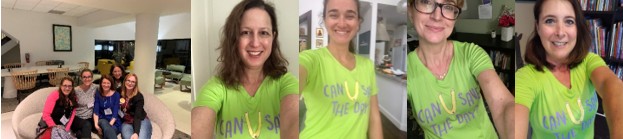
JUSTIN: Your critique group is very obviously more than a critique group – you seem to be a tight-knit, support unit. I mean… you sported matching shirts for your book’s debut! [If possible, would you and your cps be open to sharing a pic of that here?] When did you form, what’s your process and structure like, and how did you come to be so close?
SHANNON: I LOVE THIS QUESTION! I often feel like the luckiest writer on the face of the planet because of my girls (with the exception of one man in one group, my CPs are otherwise exclusively women). I met Lynne Marie through an online class in 2016, when I first started writing. When that online group broke up, Lynne formed the first of my close Facebook groups from a subset of those writers. I then met a few people through 12×12, one of whom eventually spearheaded the other Facebook group. Over time, though, friendships have blossomed when life got hard. I think it started with a text or FB message here or there about my daughter’s medical condition (she has gastroparesis). Then an occasional call. When I was scared or sad, a few of these girls opened up about similar challenges with their children. They empathized. Life struggles tied us together and forged close bonds. I chat with at least one of my partners daily now. Writing support feels almost secondary to the friendships. Several of these girls have become family to me; I can truly see us getting together as little old women, alternatively playing Heads Up, drinking wine, and writing stories in our respective corners of a cabin somewhere in the mountains. They “get” me and I feel very blessed to have them in my life.
JUSTIN: I’ve had the pleasure of speaking with your publicity manager, Julia Hlavac of Sleeping Bear Press. How and when did you begin working with her? And whose decision was it to bring her on board?
SHANNON: Julia works with all Sleeping Bear authors, and yes – she’s always quick to respond and even tries to answer questions that are out of her domain. I’ve been very appreciative for her! I think Sarah introduced me to her a couple months before the book’s release.
JUSTIN: What has Julia’s role been in all of this, and what’s your interaction been like?
SHANNON: She helps connect me with the design team for things like bookmarks, school order forms…really any marketing materials. She’s also been responsible for coordinating book signings at a couple different conferences. She sends out weekly emails to keep authors apprised about recent reviews and interviews as well, which is wonderful. I really love following news on other Sleeping Bear authors.
JUSTIN: Overall, what’s been your favorite part about collaborating with Sleeping Bear Press?
SHANNON: Hmmmm…that’s a tough one. I had an opportunity to meet a few team members at a local dinner, which was very special to me. I loved that they included me, and now consider one of the design people, in particular, a good friend. But I think my favorite part about collaborating has been the experience of working with Sarah. Many of my CPs are now published, so I hear all kinds of stories about editors who disappear for long periods of time, don’t listen to their authors’ concerns or consider their opinions, that kind of thing. I just haven’t experienced that (with either one of my editors), and I feel so fortunate for that. My vision has mattered…and I don’t take that for granted.
JUSTIN: What’s your vision for the stories you create and put out into the world?
SHANNON: My vision is different for different stories. With CAN U SAVE THE DAY, my original goal was just joy. Laughter. But as I’ve started getting feedback, I’ve realized that the story can actually help different groups of people. Children with dyslexia, reluctant readers, or children for whom English is a second language. The “lesson” in the book is so subtle that kids embrace it (I think it also helps that the book has humor). But my next PB is a nonfiction bio with an #OwnVoices backbone. I spent seven years fighting illness, two years in a wheelchair, and am a musician, so Evelyn Glennie’s story felt personal to me. I want to reach children who feel isolated because of a physical difference. I want them to believe that they can do anything. It’s really more than a “want.” I feel a visceral urgency to reach these kids, to help them recognize their own unique traits and qualities. That’s sort of the same reason I’m writing my memoir (and I’m almost done!!). The desire to spread messages of hope and self-advocacy is very, very strong for me.
JUSTIN: What’s something you believed earlier in your writing career but think about differently now?
SHANNON: I think I believed that things would move more quickly in this field than they do. Everything takes forever. I knew patience would be necessary and truly, I expected publication to take years. Rose glasses have never been my thing. But the loooooooong waits between submission and response times has been eye-opening.
JUSTIN: Where can prospective buyers purchase your book?
SHANNON: YAY! First and foremost, if you can’t buy the book (or even if you can), I’d LOVE people to contact their local libraries and request that they carry the book. Most libraries have online requests forms that take only a few seconds to fill out. It’s helpful to have the following information on hand:
Title: CAN U SAVE THE DAY
Author: Shannon Stocker
Illustrator: Tom Disbury
Publication house: Sleeping Bear Press
ISBN: 978-1585364046
BUT…if you’d like to buy a book, you can go to any of these places:
Carmichael’s (Louisville’s local store)
JUSTIN: Is there anything and/or anyone you’d like to shout out?
SHANNON: My family, for sure. My husband, Greg, has been my best friend for twenty years. Without him, I would never have quit my job to pursue writing and full-time momming. The past four years have been financially harder, but also more satisfying than any other time of my life. I feel like my job matters now. I’ve never felt that before. But also, my children. Cassidy and Tye are so much more than a constant source of inspiration for books. Because I was sick for so many years, I never thought I’d be a mother. I learned I was pregnant with Cassidy only about seven months after a coma, and I gave birth to Tye at 40. My kids are so kind, happy, and bright…they bring me joy every single day. My family is my everything.
WILDCARD ROUND:
Justin: What song best describes your life?
SHANNON: Oh this is such a difficult question for me. I have always been drawn to most of the lyrics from Landslide. It’s the song my husband and I first danced to after we eloped, it’s a song I used to sing at every gig, and my LLC is named after that song. Particularly these lyrics:
Oh, mirror in the sky, what is love?
Can the child within my heart rise above?
Can I sail through the changin’ ocean tides?
Can I handle the seasons of my life?
These words bring tears every time I hear them because I spent so much of my life questioning myself. But recently, I’ve done a lot more soul searching with lyrics. Every chapter of my memoir is preceded by a lyric that’s representative of that chapter. So overall, there are MANY lyrics that describe my life. I guess you’ll just have to read the memoir to find out what they are… J
JUSTIN: What topic could you give a 20-minute presentation on without any preparation?
SHANNON: OMG this is hysterical. I am obviously a chatty human being. With regard to writing, I could easily talk for twenty minutes on writing in verse. I love meter and rhyme. With regard to life, I could easily talk for twenty minutes about finding gratitude, self-advocacy, and maintaining hope. I’m definitely a glass-half-full kind of gal.
JUSTIN: What “weird” thing do you have nostalgia for?
SHANNON: Definitely my port. For those lucky enough not to know what this is, a port is a medical device that’s implanted for patients who frequently need to have their blood accessed (like in chemotherapy). It’s a flexible catheter that’s implanted under the skin, into a large vein in your chest. I had mine for…I think about ten years? Mine lasted much longer than expected. My disease, Reflex Sympathetic Dystrophy, has left me with horrible veins that do not support IVs or blood draws. Now that my port is gone, I need to be hospitalized to have larger veins accessed for even minor procedures that require anesthesia. My port got me through the hardest years of my life, and then some of the best years (when my children were born). For me, every needle stick is a risk that can flare my disease…but that never happened with my port. Only with peripheral sticks, for some reason. So I miss it. I miss knowing that if anything went wrong, a hospital could quickly administer medication or get blood without causing me to flare. I no longer have that security.
JUSTIN: Thanks for your time, Shannon! And again, congrats on your picture book debut, CAN U SAVE THE DAY? !
SHANNON: So many great questions, Justin. Thanks so much for having me!
Sorry, the comment form is closed at this time.