

January 15, 2020 Interview & Giveaway with Lydia Lukidis
I’m excited to welcome to the blog this week, author, Lydia Lukidis!
*Lydia is offering one lucky winner a copy of NO BEARS ALLOWED. To enter, check out the Rafflecopter giveaway following the interview below.
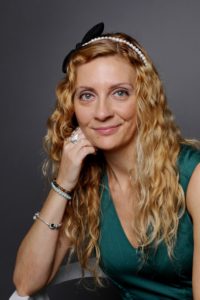 About Lydia:
Lydia Lukidis is a children’s author with a multi-disciplinary background that spans the fields of literature, science and puppetry. So far, she has 3 trade picture books, 33 eBooks, as well as over a dozen educational books published. Her latest STEM book The Broken Bees’ Nest was nominated for a CYBILS Award.
Lydia is also passionate about spreading the love of literacy. She regularly gives writing workshops in elementary schools across Quebec through the Culture in the Schools Program. Her aim is to help children cultivate their imagination, sharpen their writing skills and develop self-confidence.
Connect with Lydia:
Website
Blog
Facebook
Twitter
LinkedIn
Goodreads
Let’s kick off this interview with a game – Two Truths and a Lie. (The truth is listed right above the giveaway link following the interview below.)
1. I was part of the debating team in high school.
2. I wanted to be a writer in elementary school.
3. I took classes with Margaret Atwood’s daughter at McGill University.
courtesy of Blue Whale Press
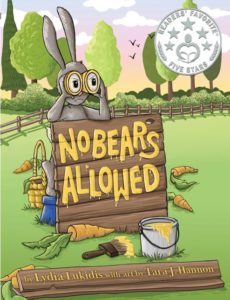
Would you please tell us a bit about your upcoming picture book, NO BEARS ALLOWED.
NO BEARS ALLOWED was published in July 2019 by Blue Whale Press. Believe it or not, the initial idea came from an inside joke. Admittedly, it makes little sense, but somehow I always felt there was something there. My inspirations are varied, they can be sparked by an image or a word, or in this case, the phrase “no bears allowed.”
I wanted the story to be about the power of friendship, and, the importance of not judging others or letting our fears govern our actions. Bear and Rabbit are different, to be sure, but they eventually learn they have more in common than they ever thought. These themes directed the flow of the entire story. But more than anything, the book is character driven, as my work often is. The characters emerge in my mind first, and then I begin to play around with possible plots.
What sparked you to write this story after having spent several years writing non-fiction? Or… Why was it yours and Rabbit’s time to share this story?
Actually, I wrote this story in 2013, when I was only in love with fiction. I had been writing since the age of 6 but I only focused on fiction. But as I learned about my craft and developed my voice, I realized, much to my surprise, that I actually love the world of nonfiction. The fact that I studied science and have a degree in Pure and Applied Science sure came in handy!
The takeaway is this: when you set out on your journey, you may have an idea of who you are or want to be as a writer. But your goals may change or evolve after spending years writing, reading, and learning. Always remain open and follow the flow.
courtesy of Blue Whale Press
Who were the team members you worked with for NO BEARS ALLOWED, and what was the process like collaborating with them?
As always, I begin with writing multiple drafts. Like other writers, I agonize over every little detail and edit nonstop. Then when I feel the manuscript is in decent shape, I show it to my critique partners. In this case, I showed it to about 5 different writers who helped me develop the text.
The story was also edited by my first agent, years ago, and I had hoped it would land a juicy contract. But that’s not how the cookie crumbled. It received a slew of rejections instead. And then, the worse happened: I parted ways with my agent.
Miraculously, I got a second agent within a few months. Yay! But, uh oh- she didn’t want to sub this story because she deemed it “too quiet.” Yes, it’s a quiet story. But it’s a beautiful, sweet story that I wanted to share with children. With my agent’s blessing, I subbed it on my own. Then another wave of rejections poured in, Until Alayne Christian, the acquisitions editor from Blue Whale Press, saw some magic in it. She invited me to revise it, and within a month, she accepted it! The road to publication was long and winding, but it was well worth it.
If you had to describe the collaboration process with three adjectives, which adjectives would you choose?
In this order: frustrating, illuminating, and exhilarating.
courtesy of Blue Whale Press
I saw that Blue Whale Press allowed you to choose your illustrator. How did all of that go down? [from them allowing that and you finding Tara and her work, to you proposing your selections and the illustrator signing on]
This is one of the many benefits of working with a small press, although they don’t always give you this privilege. I was lucky because Blue Whale Press sent me a myriad of options in terms of illustrators, and we all fell in love with Tara Hannon’s work.
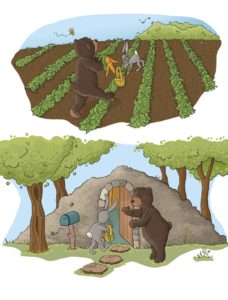
I do trust publishers to make this decision on their own, but it’s an added bonus to have a say in the matter. I was also grateful to have some say in how to illustrations developed, though I learned many valuable lessons in the process. Number 1: give the illustrator space to bring their own ideas to the table (magic happened and Tara had so many wonderful ieas I have never imagined). Number 2: TRUST them and the process, and refrain from becoming obsessive with art notes. That was tough for me at first because of my control freak tendencies. I had such a clear vision of the book, but as I learned to let go, that’s when it truly came to life.
What was it about Tara’s aesthetic that appealed to you for this story?
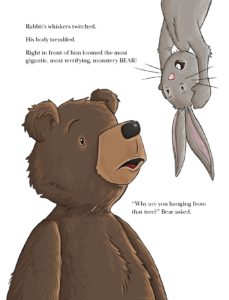
Personally, I love watercolors, and Tara often plays in that format. But more than that, I appreciate and am drawn to artwork that makes me FEEL something. I love illustrators with a strong point of view, and I’m also a sucker for anything whimsical or magical. Tara exemplifies all of this. And she turned out to be a true delight to work with, and a friendship between us grew from that process.
courtesy of Blue Whale Press
How did your characters and overall story evolve as a result of the illustration process? Was there anything in particular that changed drastically and/or really surprised you?
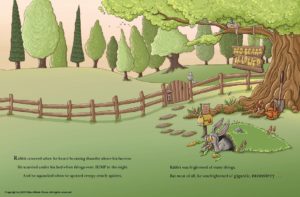
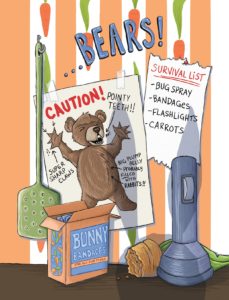
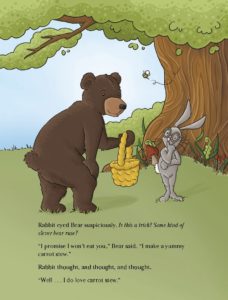
Yes! Great question, nobody ever asked me that before. The main issue was that I always imagined Rabbit to be an “elderly” bunny, set in his ways, wearing spectacles. But Alayne suggested that children won’t identify with such a character, and why not make him younger? Admittedly, I wasn’t feeling this characterization for a while. But- then Tara showed me her first draft of Rabbit. He was young and fresh, with a worrying look in his eyes and a pair of binoculars safely attached around his neck. I was sold. This goes to show: the relationship between writer, editor and illustrator is not only sacred but also symbiotic. We all breathe life into the character and story and help bring forth their best version.
What’s it like working with a boutique publisher in terms of publicizing and promoting your work?
I haven’t yet worked with the Big 5, but from what I hear, each house (from big to small) has its own protocol when it comes to publicity and promotion. For example, I have colleagues who published with the Big 5 but received zero help from the marketing team, while others who worked with smaller houses receive more help and guidance. So you just have to deal with what you’re given.
I’m pleased to say that Blue Whale Press has supported me every step of the way. For example, they provided me with a comprehensive list of reviewers and bloggers, and they contacted the big ones themselves. They are always ready to tweet and post about all their books, so I’m happy the effort is there on their part. As for me, I’m a hustler when it comes to promotion and I devoted a lot of time and effort to spreading the word.
courtesy of Blue Whale Press
So, your mc is this nervous, scared rabbit. Is there anything particular about this book or the process of bringing it to shelves that made you nervous or scared you?
First of all, I should mention that Rabbit is partially based on me! I’m a fairly nervous person by nature. I sometimes have a hard time with dealing with the unknown and find change to be challenging. But I’m also very introspective and I’m always trying to grow and face my fears head on. Oddly enough, I’m fearless when it comes to my business life, but sometimes feel crippled with fear in my personal life. I’m a work in progress!
When it came to bringing the book into the world, I was of course apprehensive about the reaction of the reviewers. I’m happy to say that most reviewers had positive things to say. But I did get one review that was somewhat “negative.” I had to face my worst nightmare. I admit I wanted to hide under the covers for a week. I know I shouldn’t take it personally, but somehow I did. I eventually shrugged it off, and learned from the experience. Not everyone may love your work, and that’s ok. What matters is that you write from the heart, and continually develop your craft.
You’ve shared that earlier drafts of the book were didactic. How did you correct that, and do you have any tips or words or wisdom for authors who might be facing a similar challenge?
Oh yes, the journey to becoming less didactic has been a long one! That was one of my major challenges. I’m finally making some headway, though it can still be a struggle with certain books. For me, the process is all about TRUST. You have to trust that children will see the magic, and will read between the lines. Children are smart and you don’t need to explain every little thing to them. You have to infuse your work with feeling, and stray away from explanations. That’s particularly hard with nonfiction. Over the years, many agents and editors have told me certain books were too “educational” and “teachy.” The best way to combat this is to read mentor texts, take courses/webinars, and keep writing.
courtesy of Blue Whale Press
You’ve also shared, like many authors, that you had to let go of certain ideas and parts of the story you became attached to. What were some of those ideas and parts, and how did letting them go serve the story?
Another great question! In short, an author has to be willing to let go of it ALL. Being attached to your writing will not serve you, you’ll remain stagnant and never learn. Growing means being uncomfortable, and pushing through your limits. That’s when extraordinary writing happens.
For example, I have a PB that I love. But try as I might, I wasn’t able to sell it. At a certain point, you need to ask yourself, why is everyone saying no? Yes, you might have already revised it 100 times, but it may still need work. I was so attached to the voice of my protagonist that I had a hard time editing it. But once I surrendered and make the commitment to bring the text to the next level, something interesting happened. The ENTIRE text changed! I basically wrote a whole new story and didn’t keep any of the original phrases, but it was so much better.
Is there anything you’re currently working on that you’d like to share with us?
I’m currently querying agents (third time will be a charm, I hope!). After parting ways with my second agent, I lost hope for a while. But all these experiences have made me stronger, and I bounced back with even more resolve. I’m querying a few stories, but my passion project is a nonfiction picture book about a remote place on earth. I’m also excited about a nonfiction middle grade novel I’ve been working on, stay tuned for more details!
Check out NO BEARS ALLOWED here:
The trailer: Youtube
Amazon
Indiebound
Bookdepository
Two Truths and a Lie:
I wanted to be a writer in elementary school- lie! Although all I did was write, somehow, young Lydia wanted to be a ballerina! That did not work out.
Thanks for your time, Lydia!
Thank you for having me!
Sorry, the comment form is closed at this time.