

April 20, 2018 Interview with Literary Agent Emily Mitchell of Wernick & Pratt
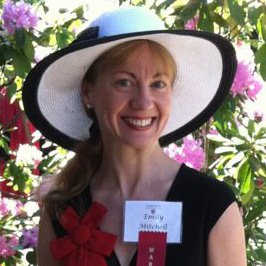 About Emily:
I grew up in the Midwest, came east for college, and stayed. I was supposed to be a teacher, and went as far as getting an MSEd in secondary English education, but I fell into a job in children’s publishing and got hooked on the industry. I was an editor at Charlesbridge for eleven years before moving over to agenting at Wernick & Pratt in 2013. I’m a singer, baseball fanatic, dog lover, and Doer of Things. I live with my husband and two kids outside Boston.
Connect with Emily:
WPA is at @wernickpratt
and https://www.facebook.com/wernickprattagency/.
Personal Twitter is @emilyreads.
Why and/or how did you become an agent?
My first job in publishing was at a literary agency, where I learned all aspects of the business – not just submissions and rejections, but contracts, foreign rights, royalties, and more. After two+ years of that, I wanted to move to the editorial side of the business, where I felt my skills were a better fit. During my years as an editor at Charlesbridge, I went back to school for my MBA, and starting picking up more responsibilities within the business side of publishing. I took a break to work in marketing communications for a large printing company, but didn’t find that work as fulfilling as children’s books. When I was laid off in a corporate restructuring, it was the right kick in the pants to make my way back to books. I had reconnected with Linda Pratt and Marcia Wernick, with whom I’d worked at my first job and who now had started their own agency, and the timing was right for me to try agenting. It’s been a great fit for me professionally – keeping my editorial skills sharp and applying my business education and experience – and personally, as I juggle two busy kids with fulltime (but flexible!) work.
Where are you based?
I work from my home outside Boston (I’m the “Massachusetts office” of the agency).
How has technology influenced your relationship with your clients?
Thanks to the interwebs, I can work with clients all over the world (I have one in Japan, for example). I tell my clients upfront that I’m more of an email person than a phone person, which means they can reach me whether I’m sitting at my desk or, as often happens, waiting outside a kid’s music lesson or walking with the dog to the post office. Sharing work online has never been easier, either.
What are some of the challenges technology poses to agent-client relationships?
Social media is a double-edged sword, for me. I’m FB/Twitter friends with some clients and industry colleagues, but not all, and there’s no particular rhyme or reason to that. If I were starting over, I might make a clearer distinction between my work friends and my IRL friends online – not because I want to hide anything, but just to keep professional relationships professional. It’s one thing to be open about my ALL-CAPS RELATIONSHIP with the Red Sox and Cubs, and another to talk about things going on in my family, town, or church to people who might know me only in an asymmetric professional context (a client, an aspiring writer, an editor I’m negotiating with, etc.).
Additionally, the downside to being online/available all the time is sometimes there’s an expectation of being available all the time – that I should answer emails at night or on the weekends, for example. Sometimes I can and I do; sometimes I can’t or I won’t.
What’s a day in the life of literary agent Emily Mitchell like?
Three days a week I start my workday with a Skype call with my colleagues, going over what we’re all working on and discussing any pressing issues. Then it’s a mix of reviewing contracts, reading client manuscripts, drafting permissions, updating our website and social media, and reviewing submissions. In the late afternoon the kids get home from school, so I’m often transformed into Parent Taxi for music lessons, doctor appointments, and softball games. I usually do a little more work at night, and between April and early November I’ll be watching baseball in some capacity in the evenings.
What do you love most about your job?
I love books; I love stories; I love art. I love getting to work with all three every day. I love the crazy rabbit holes of research that children’s books can send me down, because it’s so important to get things right (“What was the prime-time TV lineup on Mondays in 1983?” and “Do chickens have lips?” were both real questions that arose from books I worked on).
What are some of your goals within the industry? Overall vision for yourself?
I’d like to help my clients build a solid backlist and keep trying new things. I’d like to find a few more up-and-comers and help them make their mark – that’s a really rewarding part of my job.
Imagine we’re dive to ten years into the future …. What accomplishments are you most proud of?
I’d like to have played a role in bringing more underrepresented groups into the industry, either as clients or colleagues. And I can’t help but want to see a client win a Caldecott, Newbery, or Printz.
Is there a specific project you’ve recently sold that you’re especially excited about?
I’ve got a couple forthcoming middle grade novels that I’m excited about. In both cases, I took on the client on the strength of the manuscript: one sold fairly quickly, but the other took a while before we found the perfect editorial fit. Karla Manternach’s MEENA MEETS HER MATCH is coming from S&S, and Keith Calabrese’s A DROP OF HOPE will be published by Scholastic, both in 2019. And I have too many awesome picture books coming soon to mention . . .
What would be your dream project? Dream big!
I’d love to have a project that earns both critical and commercial success – the kind of project that’s strong on craft (getting starred reviews and, ideally, awards) but also becomes a bookstore and classroom favorite.
What sets a great manuscript apart from the rest of the crowd for you?
Everybody answers this question with “voice,” which is subjective and probably unhelpful, but in truth, the answer is “voice.” If the writing, the narrative voice, grabs me and doesn’t let go – whether it’s funny or lyrical or disturbing – I’m much more likely to keep reading.
What’s on your #MSWL?
I’m always looking for strong contemporary middle-grade. I love funny. I like MG and YA nonfiction with social/historical themes and a compelling, weirdo hook (find me the MG Mary Roach!).
Anything that’s definitely not a fit for you?
I’m not the best for high fantasy or science fiction, though I do have some favorites within those genres.
What’s your ideal client like? Or what do you hope to see in a client? What makes a successful author-agent relationship?
I love working with people who are dependable and flexible: they meet deadlines, they take and incorporate feedback, and they thrive on the collaborative nature of our industry. I like clients who aren’t afraid to tell me when something isn’t working, and who in turn can react and respond constructively to critiques. I also appreciate clients who are responsive, so I don’t have to chase down answers or deliverables.
How do you champion your clients? Or what’s a unique way in which you champion your clients?
I’d maybe point to the agency’s social media presence, which I handle. I’m always looking for good news and interesting tidbits to share about our clients. For the past couple summers, for instance, we’ve done a regular ‘Summer Art Showcase,” featuring a different illustrator client every other day. And I always highlight starred reviews, awards, and book deals when they’re published. For us, social media is both promotion and author care – and sometimes the latter is the more important focus.
Do you receive many manuscripts from diverse authors?
It’s tough to say. Most of the people who submit to me don’t identify themselves by race or ethnicity, so I’d have to guess using dicey criteria (author names? context clues? There’s not much that wouldn’t quickly fall into stereotypes). I would guess that I don’t.
What diverse groups do you feel are especially underrepresented within the industry? As characters within novels?
Is it a cop-out to say “anybody who doesn’t look like me or have a similar background”? I represent the average and mode of industry employees from Lee & Low’s 2015 Diversity Baseline Study: I’m white, cis/hetero, female, and nondisabled. Most of my colleagues within the industry are, too. That’s a huge barrier to increasing diversity within the books we publish. I think characters in books are more diverse than the staff who publish them, but we still have a long way to go: I still see a lot of “white protagonist with POC/disabled/queer sidekick” stories presented as the solution to a lack of diversity.
What do you perceive to be some of the greatest challenges to that “collective bookshelf” you speak of?
As noted above, gatekeepers like me are a big one. I used to use words like “universal” to describe stories about experiences I recognized and understood, especially if some element of the story was new to or different from me (a first-day-of-school story set in Ghana, e.g.). I meant it as a compliment. What I’ve come to understand more recently, however, is that my measure of what constitutes “universal” or default is necessarily – and sometimes harmfully – limited. So it’s incumbent on me, as I’m reviewing manuscripts, not to rely solely on Internal Kid Reader Emily, with her limited viewpoint, as the final arbiter of what readers want and are interested in. I have to be wise enough and open enough to think about what readers who aren’t like me, and the parents and other adults who help choose their books, want to read and see in their stories. And I get to enjoy those stories as well!
You’ve said you’d like to see more characters of different socioeconomic backgrounds… Would you elaborate on that?
I feel like often when I read a book about a character who’s poor, their poverty is the focus of the story. I’d like to see more families like Clementine’s: both parents work, but their jobs aren’t especially lucrative or admired – and that’s not critical to the story; it just is. I’d like to see more characters who have to take public transportation (and not just in New York) because they don’t have two and three cars. I’d like to see discussions about finances presented more often and more matter-of-factly than I do now. I worry that too much of our popular culture is aspirational to the extreme, and creates unrealistic expectations of what we’re supposed to be able to do and afford.
How do you approach and encourage diversity?
Right now my main focus is reading: keeping up-to-speed on current books by authors from a variety of backgrounds (i.e., non-white, non-cis, disabled, etc.). I haven’t always done a good job keeping my own TBR pile diverse, so that’s an ongoing goal. I also try to promote books that reflect diversity, both for my own kids and in recommending titles to friends or online. With my clients, I try to nudge them to think more broadly and deliberately about characterizations and stereotypes in their manuscripts.
Any advice for authors regarding crafting diverse characters? Pitfalls to avoid?
Know what you’re talking about, and if you’re writing outside your culture, be extraordinarily mindful to get it right. Seek out sensitivity readers (AND PAY THEM) – more than one, ideally. Read the work of scholars of children’s literature (e.g., Dr. Ebony Elizabeth Thomas of Penn’s GSE: https://www.gse.upenn.edu/news/ebony-elizabeth-thomas-diverse-books-children ). Recognize that you may screw up, and if/when you do, fix it. Be humble.
What are some ways you feel agents can increase diversity within the publishing industry?
Being vocal about wanting to represent POC is a big one, although it needs to be genuine and not just bandwagon-y. If an agent has the capacity to hire assistants or readers, hiring people from diverse backgrounds is critical. Supporting and submitting to editors and art directors who are non-white or otherwise diverse is also important: if we want our industry to look more like our world, we need to help those colleagues succeed.
Are there any upcoming conferences or twitter events you’ll be participating in?
I’ll be at ALA Annual at the end of June, but that’s about it for travel this year.
Final advice for writers and/or illustrators?
Read. FTLOG, read – current books and backlist titles, broadly and closely. Reading widely helps you not only understand the market, but also improve your own craft.
Wildcard Questions:
If you could spend a day with any person, living or dead, who would it be?
I’d like to have drinks with Eleanor Roosevelt. I expect she has a ton of stories . . .
What’s your spirit animal and why?
Um. “Spirit animal”? Let’s try that a different way. If you mean some creature or inanimate object that represents my personality in a shorthand way, I’d either go with my dog (small, occasionally fierce, prefers sleeping, highly motivated by food) or a black Sharpie (steady, dependable, not necessarily flashy, but gets the job done definitively).
If you could have any career (outside of publishing), what would it be and why?
I was supposed to be a teacher, and I still love working with teenagers, so I suppose I’ll go with that. Unless I could spontaneously become Sutton Foster.
Thanks for your time, Emily!
Sorry, the comment form is closed at this time.